
What Does "Land Area" Actually Mean in Property?
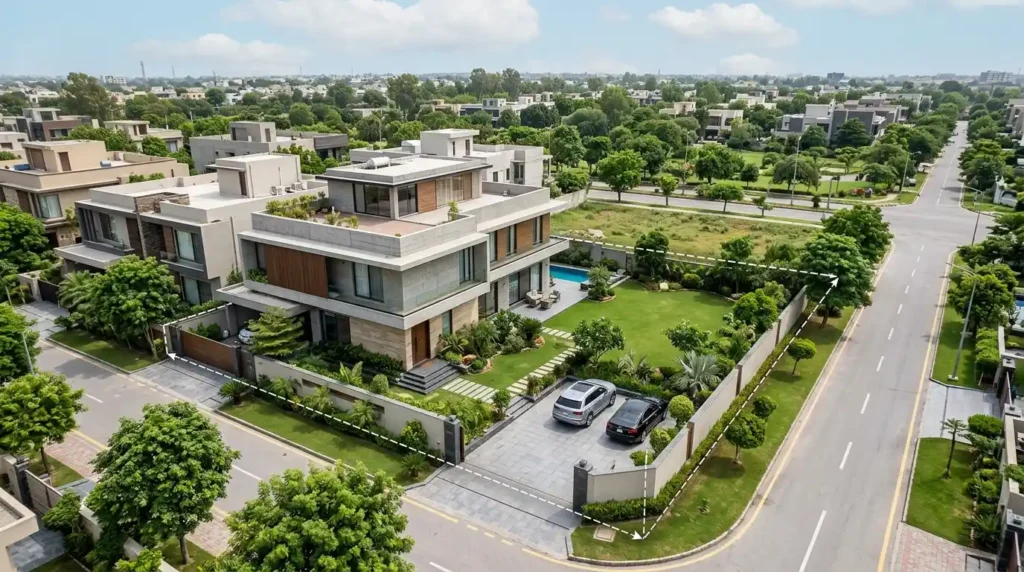
Scroll through any property listing and you’ll run into terms like land area, plot area, property size, covered area, square feet, square yards, marla, and kanal — often used loosely, sometimes interchangeably, which is exactly why buyers get confused.
Here’s the straightforward answer:
Land area is simply the total size of the land tied to a property — measured in square feet, square yards, square metres, marla, kanal, or acres, depending on where you are.
Example: a plot measuring 40 feet by 60 feet has a land area of:
40 × 60 = 2,400 square feet
Getting comfortable with this term matters because it’s the foundation for comparing plots, estimating how much space you’re actually getting, and reading listings without second-guessing every number. For more real estate basics explained simply, check out Al Rauf Group’s Property Basics section.
So what is land area, exactly?
Land area is the total space contained within a property’s boundaries — the land itself, not what’s built on it.
A property might have:
- Land area: 500 square yards
- Covered area: 3,500 square feet
- Two floors, a garden, parking, and some open space
That 500 square yards is the land. The covered area is a completely separate number describing what’s actually constructed. These two figures are not the same thing, and mixing them up is one of the most common mistakes buyers make.
Is land area the same as plot area?
Generally, yes — in most listings, “land area” and “plot area” both refer to the size of the land a property sits on.
So if a listing says:
Plot size: 2,000 sq. ft.
that’s telling you the land area is 2,000 square feet.
That said, terminology isn’t always consistent across developers, housing societies, and official documents. When it matters, check the exact definition being used rather than assuming. For more on this, see Al Rauf Group’s Property Insights collection.
Land area vs. covered area — what’s the real difference?
Land Area = the total land
Covered Area = the constructed/built portion of it
Say you’ve got a house on a 500 sq. yd. plot. The land area stays 500 sq. yd. no matter what. But the ground-floor covered area might only be 300 sq. yd., leaving 200 sq. yd. open for a driveway, garden, or courtyard.
If the house has multiple floors, the total covered area (adding up every floor) can end up bigger than the plot’s land area — which trips up a lot of buyers who assume land size and building size are the same thing.
How do you calculate land area?
For a rectangular plot, it’s just length × width.
Example 1: 40 ft × 60 ft = 2,400 sq. ft.
Example 2: 50 ft × 80 ft = 4,000 sq. ft.
Irregularly shaped plots are harder to pin down exactly — you’ll usually need a professional survey or the dimensions listed in official documents rather than a rough estimate.
What units are used to measure land in Pakistan?
It depends heavily on where you are. Common units include:
- Square feet
- Square yards
- Square metres
- Marla
- Kanal
- Acre
Karachi and Sindh listings tend to use square feet and square yards. Punjab and Islamabad-area properties lean toward marla and kanal. Always confirm which standard applies to the specific property you’re looking at — don’t assume it matches what you’re used to seeing elsewhere.
What is a square foot?
A square foot is exactly what it sounds like — a one-foot by one-foot square. A 10 ft × 10 ft room comes to 100 sq. ft. It’s the go-to unit for houses, apartments, shops, offices, and covered areas across most of the country.
What is a square yard?
A square yard is a three-foot by three-foot square. Since one yard equals three feet:
1 square yard = 9 square feet
So 100 square yards works out to 900 square feet. You’ll also hear this called gaj or gaz in a lot of Pakistani property conversations — same thing, different name.
What is a marla — and why isn’t it always the same size?
This one catches out even experienced buyers.
A marla is a traditional South Asian land unit, but here’s the important part: it’s not standardized across every housing scheme or region.
Some areas use 225 sq. ft. per marla. Others use the more traditional 272.25 sq. ft. standard. So “5 marla” in one scheme isn’t necessarily the same actual size as “5 marla” somewhere else.
Before you assume anything, confirm the standard being used through the property documents, the housing society, the relevant development authority, or the seller directly. This matters a lot more when you’re comparing properties across different cities or schemes.
What is a kanal?
A kanal is another traditional unit, and the commonly used relationship is:
1 kanal = 20 marla
But since marla itself varies, the square-footage equivalent of a kanal can shift depending on which standard is being applied. One common figure is:
1 kanal = 5,445 sq. ft.
— though this can differ by housing scheme. The safest move, again, is checking the actual number stated in your property documents rather than relying on a general rule of thumb.
What is an acre?
An acre is a much bigger unit, typically used for large plots, agricultural land, and development projects.
1 acre = 43,560 square feet
1 acre = 4,840 square yards
For very large transactions, you might also come across hectares or other regional units.
Quick conversion reference
| Measurement | Equivalent |
|---|---|
| 1 square yard | 9 square feet |
| 1 square metre | ~10.764 square feet |
| 1 acre | 43,560 square feet |
| 1 acre | 4,840 square yards |
Marla and kanal don’t get a fixed line here on purpose — always verify those locally, since they genuinely vary by region.
Why does land area actually matter when you’re buying?
Price. Land size is one factor in property value, but far from the only one. Location, road access, condition, construction quality, amenities, and demand all play a role too.
How much you can build. More land generally means more room to construct — but not automatically. Setbacks, parking requirements, height limits, and maximum coverage rules can all restrict how much of the plot you’re actually allowed to use. Always check with the relevant authority before assuming.
Outdoor space. A bigger plot usually means more room for a garden, driveway, parking, or outdoor seating — a real consideration if you want an independent house rather than an apartment.
Future plans. If you’re thinking about extending or redeveloping down the line, land area matters — but so do the approved plans, structural limits, and current regulations governing what you’re allowed to add.
Does more land automatically mean a better property?
No — and this is worth internalizing before you fall for the “bigger is better” trap.
Property A: 500 sq. yd., older construction, limited parking, less convenient location
Property B: 300 sq. yd., modern build, better layout, strong road access, more convenient location
Depending on what you actually care about, Property B could easily be the smarter buy despite the smaller plot. Land area only tells part of the story — weigh it against location, construction quality, layout, and price together.
How does land area affect property value, really?
Bigger land can mean more value, especially somewhere land is genuinely scarce. But it’s rarely that simple.
Two properties both sitting on 500 square yards can have very different price tags because one has better road access, a corner position, stronger construction, or simply sits in higher demand. Compare properties with similar characteristics — not just similar size — to get an honest read on value.
Land area in houses vs. plots
For residential property, land area gives you the full picture of what comes with the house — garden, garage, parking, driveway, courtyard, open space, all of it.
The two questions worth asking yourself are:
How much land is there in total?
How much of that land is actually developed or covered?
Answer both, and you’ll have a far more realistic sense of what you’re buying than just the headline plot size.
Land area in commercial property
For commercial land — shops, offices, warehouses, retail buildings — land area still matters, but factors like frontage, visibility, accessibility, and permitted land use often carry just as much weight, sometimes more. A large plot tucked away with poor access can be worth far less than a smaller plot fronting a busy commercial road.
Land area in apartments — where it gets more complicated
Apartment listings throw a lot more terms at you: apartment area, covered area, saleable area, gross area, usable area, common area. None of these are guaranteed to mean the same thing across different projects.
The one question that clears up most confusion:
“What exactly does this stated area include?”
Ask it every time before comparing two apartments — otherwise you might be comparing numbers that were calculated completely differently.
What to check before buying land
Confirm the actual land area stated in the official documents — not just what the agent tells you.
Check the dimensions, not just the total. A 2,000 sq. ft. rectangular plot and an oddly shaped 2,000 sq. ft. plot can be practically very different to build on or use.
Verify ownership through proper transfer and ownership records.
Confirm the actual location — visit it yourself rather than trusting an ad.
Check road and street access.
Find out the development status — is it built up, under construction, or still just planned?
Understand what you’re legally allowed to build on that land.
Compare similar properties in the same area, not different neighborhoods.
Get professional verification of the measurements if there’s any doubt.
Common mistakes people make with land area
Assuming every marla is identical. It isn’t — always verify the local standard.
Confusing land area with covered area. One is the land, the other is the building. Different things entirely.
Judging a plot only by total square footage. Shape and dimensions matter just as much as the raw number.
Assuming the whole plot can be built on. Setbacks and open-space rules usually limit this.
Comparing properties measured under different standards. A property measured one way isn’t automatically comparable to one measured another way.
Land area, property size, and covered area — the terms compared
| Term | What It Generally Means |
|---|---|
| Land Area | Total land within the property’s boundaries |
| Plot Area | Size of the plot/land |
| Covered Area | The constructed or built portion |
| Usable Area | Space you can practically use |
| Saleable Area | Area used for marketing/pricing purposes |
Definitions can shift slightly by project and documentation, so treat this table as a general guide, not a fixed rulebook.
A simple worked example
Say a plot has these dimensions:
Front = 50 ft, Depth = 80 ft
Land area = 50 × 80 = 4,000 sq. ft.
Now the owner builds a house covering 2,500 sq. ft. at ground level.
That leaves:
Land area: 4,000 sq. ft.
Ground-floor covered area: 2,500 sq. ft.
Open area: 1,500 sq. ft.
That open 1,500 sq. ft. could be parking, garden, a driveway, or required setbacks — depending on the design and local rules.
Why land area alone doesn’t tell you everything
See a listing that just says:
“House for Sale — 500 Sq. Yards”
That number tells you the land size. It tells you nothing about how big the actual house is, how many floors it has, how much parking exists, how much garden space there is, or what the layout looks like inside. Always read the full listing — or ask directly — before drawing conclusions from one number.
Frequently asked questions
What is land area in property?
The total land within a property’s boundaries, measured in square feet, square yards, square metres, marla, kanal, or acres depending on location.
Is land area the same as plot area?
Usually, yes — both typically describe the size of the land. But always confirm the exact definition in the listing or official documents, since terminology can vary.
How do you calculate land area?
Multiply length by width for a rectangular plot. A 40 ft × 60 ft plot equals 2,400 sq. ft.
What’s the difference between land area and covered area?
Land area is the total land. Covered area is just the constructed or built portion of that land.
What units measure land in Pakistan?
Square feet, square yards, square metres, marla, kanal, and acres — the preferred unit depends on the region and property type.
How many square feet in a square yard?
9 square feet.
Is a marla the same size everywhere in Pakistan?
No. It can be 225 sq. ft. in some schemes and 272.25 sq. ft. in others. Always verify locally.
Does more land mean higher value?
It’s a factor, not the deciding one. Location, access, construction, condition, and demand matter just as much.
Can you build on the entire plot?
Not always. Setbacks, parking rules, and coverage limits set by local authorities often restrict this.
Why verify land area before buying?
It confirms the property actually matches what’s documented, and lets you compare properties fairly instead of relying on guesswork.
Bottom line
Land area, in the simplest terms, is just the total land within a property’s boundaries — measured in whatever unit is standard for that region, whether that’s square feet, marla, kanal, or acres.
But never look at land area in isolation. Pair it with the property’s dimensions, location, construction quality, covered area, documentation, access, and total cost before making any decision.
For more beginner-friendly real estate guidance, visit Al Rauf Group’s Property Basics and the full Property Insights collection.