Planned Communities vs Unplanned Housing Developments
Introduction
Real estate in Karachi has evolved rapidly over the last two decades. As the city expands, buyers are increasingly faced with an important decision:
Should you invest in a planned community or an unplanned housing development?
At first glance, both may appear similar—plots, apartments, and residential units. But in reality, the difference between them can significantly impact lifestyle, security, and long-term investment returns.
Understanding planned communities vs unplanned housing developments is essential for anyone looking to buy property in today’s market.
What Are Planned Communities?
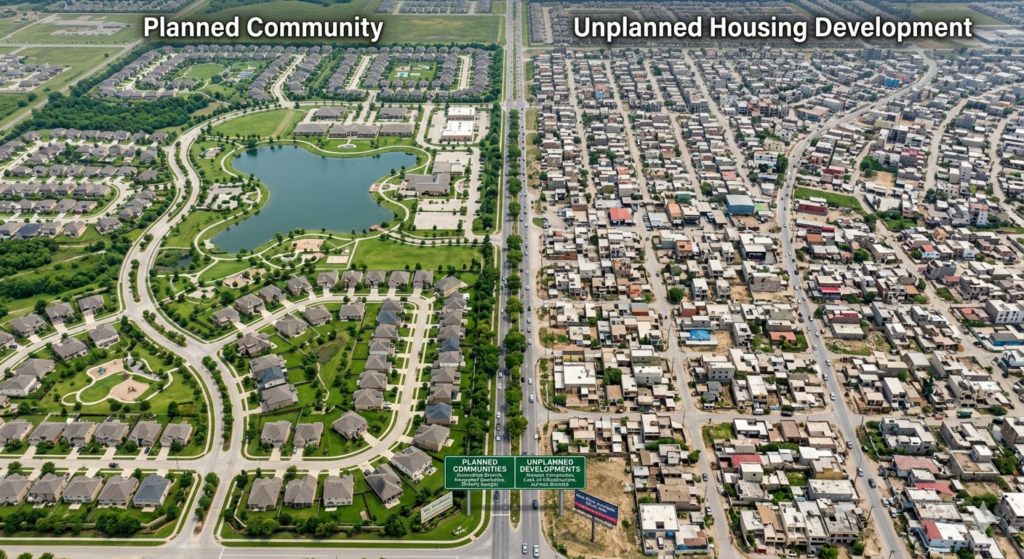
Planned communities are residential developments designed with a structured layout, infrastructure, and long-term urban planning in mind.
These projects are developed by organized developers who plan roads, utilities, parks, security systems, and community facilities before residents move in.
Key Features of Planned Communities
✔ Organized road networks
✔ Dedicated security systems
✔ Parks and green areas
✔ Proper drainage and utilities
✔ Commercial zones within the project
✔ Managed maintenance systems
✔ Family-friendly environment
Planned communities are designed to provide a complete lifestyle, not just housing units.
What Are Unplanned Housing Developments?
Unplanned housing developments refer to areas that grow organically without proper master planning.
These are often developed through individual plots, informal layouts, or rapidly expanding neighborhoods without centralized infrastructure planning.
Key Features of Unplanned Developments
✔ Irregular road layouts
✔ Limited or inconsistent infrastructure
✔ Mixed construction standards
✔ Lack of centralized maintenance
✔ Basic or unmanaged utilities
✔ Limited community facilities
While these areas may still be livable, they often lack long-term structural planning.
Planned Communities vs Unplanned Housing Developments: Key Differences
| Feature | Planned Communities | Unplanned Developments |
|---|---|---|
| Urban Planning | Structured | Unstructured |
| Infrastructure | Well-developed | Inconsistent |
| Security | Organized systems | Individual arrangements |
| Amenities | Parks, facilities, community spaces | Limited |
| Maintenance | Managed professionally | Informal |
| Property Value Growth | Stable & consistent | Unpredictable |
| Resale Demand | High | Variable |
| Lifestyle Quality | Modern & organized | Basic |
Infrastructure Quality: The Biggest Difference
Infrastructure is one of the strongest indicators of long-term property value.
Planned Communities
Planned developments are built with:
✔ Proper road widths
✔ Underground utilities (in many modern projects)
✔ Drainage systems
✔ Electricity and water planning
✔ Waste management systems
This creates a more reliable living environment.
Unplanned Developments
Infrastructure in unplanned areas often develops over time and may face:
- Road congestion
- Water supply issues
- Irregular electricity connections
- Lack of proper drainage
- Uneven construction standards
These challenges can affect both lifestyle and property value.
Security and Safety Considerations
Security has become a top priority for modern homebuyers.
Planned Communities
Most planned communities offer:
✔ Gated entry points
✔ CCTV monitoring
✔ Security personnel
✔ Controlled visitor access
✔ Organized surroundings
This creates a safer environment for families.
Unplanned Developments
Security in unplanned areas often depends on:
- Local arrangements
- Individual efforts
- Public law enforcement
The level of safety can vary significantly from street to street.
Lifestyle and Living Experience
Planned Communities
Residents enjoy:
✔ Clean and organized surroundings
✔ Parks and recreational areas
✔ Community events and spaces
✔ Reduced traffic chaos
✔ Family-friendly environment
These features improve overall quality of life.
Unplanned Developments
Lifestyle in unplanned areas may include:
- Busy streets and mixed land use
- Limited recreational facilities
- Higher noise levels
- Less organized surroundings
While some areas are vibrant and active, they may lack structured community living.
Investment Perspective
From an investor’s point of view, both options behave differently in the market.
Why Planned Communities Attract Investors
✔ Higher buyer confidence
✔ Strong resale demand
✔ Stable long-term appreciation
✔ Better rental appeal
✔ Organized development vision
Planned communities are often considered lower-risk investments.
Challenges in Unplanned Developments
Unplanned areas may offer:
✔ Lower entry prices
✔ Early investment opportunities
But they also carry risks such as:
- Slower appreciation
- Uncertain infrastructure development
- Variable demand
- Maintenance issues
Why Buyers Prefer Planned Communities in Karachi
Karachi’s growing population and rising demand for organized housing have significantly increased the popularity of planned developments.
Key reasons include:
- Demand for secure living
- Urban lifestyle expectations
- Family-oriented housing needs
- Better infrastructure planning
- Long-term investment safety
As a result, many modern residential projects are shifting toward planned community models.
Al Rauf Group’s Approach to Planned Residential Living
At Al Rauf Group, we focus on developing structured residential environments designed for long-term value and modern living.
Al Rauf Group is contributing to this transformation through residential developments focused on:
- Affordable apartment living
- Family-friendly communities
- Flexible installment plans
- Long-term investment value
Al-Rauf Smart City
Ideal for modern apartment living with flexible installment plans.
Visit: Al-Rauf Smart City
Al-Rauf North Vista I & II
Popular for family apartments and installment-based ownership.
Visit: Al-Rauf North Vista I & II
Al-Rauf Gold Raas
Affordable residential investment opportunities.
Visit: Al-Rauf Gold Raas
Al Rauf Gold Residency
Family-oriented apartment project with modern amenities.
Visit: Al Rauf Gold Residency
China Town Residency
Modern apartment living for urban buyers.
Visit: China Town Residency
Final Verdict: Gated Communities vs Traditional Neighborhoods
There is no universal answer when comparing Gated Communities vs Traditional Neighborhoods.
Gated Communities Are Best For:
✔ Families seeking security
✔ Buyers who value modern amenities
✔ Long-term residential living
✔ Investors targeting premium demand
Traditional Neighborhoods Are Best For:
✔ Buyers seeking central locations
✔ Residents who value established communities
✔ Investors looking for mature rental markets
✔ Individuals preferring urban convenience
Ultimately, the best choice depends on your lifestyle, priorities, and investment objectives.
As Karachi continues to evolve, both gated communities and traditional neighborhoods will remain important parts of the city’s residential landscape.
Frequently Asked Questions
What is a planned community in real estate?
A planned community is a residential development designed with structured infrastructure, security, amenities, and long-term urban planning.
What are unplanned housing developments?
Unplanned developments are areas that grow without formal planning, often resulting in irregular infrastructure and limited facilities.
Which is better for investment: planned or unplanned developments?
Planned communities are generally considered better for long-term investment due to stability, infrastructure, and demand.
Do planned communities have higher property values?
Yes, planned communities often maintain stronger and more consistent property appreciation over time.
Why are planned communities becoming popular in Karachi?
Growing demand for secure, organized, and modern living environments is driving the popularity of planned developments.
Are unplanned areas risky for investment?
They can offer lower entry prices but may carry risks such as uncertain infrastructure and unpredictable appreciation.
Can unplanned areas become planned over time?
Some areas do improve with development, but it depends on government planning and infrastructure investment.