Investing Early vs Buying at Project Completion: Which Real Estate Strategy Delivers Better Returns?
Introduction
Real estate has long been considered one of the safest and most rewarding investment options in Pakistan. Whether you’re purchasing your first apartment, building an investment portfolio, or planning for your family’s future, one decision can significantly influence your returns:
Should you invest during the early stages of a project, or wait until construction is complete?
Both strategies have their advantages. Investing early often provides lower prices and greater appreciation potential, while buying a completed project offers certainty and immediate usability. The right choice depends on your financial goals, risk tolerance, and investment timeline.
In this guide, we’ll compare both approaches to help you make an informed decision.
Understanding Early-Stage Property Investment
Investing early often called pre-launch or under-construction investing means purchasing a property before or during the initial phases of development.
At this stage, developers typically introduce the project with attractive pricing and flexible payment plans to encourage early buyers.
Instead of purchasing a finished apartment, investors secure a unit based on approved plans, layouts, and project specifications.
What Does Buying at Project Completion Mean?
Buying at project completion means purchasing a property after construction has been completed and the project is ready for possession.
At this stage, buyers can physically inspect:
- Construction quality
- Apartment layouts
- Community amenities
- Parking facilities
- Common areas
- Finishing standards
This approach reduces uncertainty because buyers know exactly what they are purchasing.
Why More Investors Are Buying Earlier Than Ever
Across Pakistan, experienced investors increasingly prefer entering projects during their early stages.
Why?
Because real estate values often increase as development progresses.
As construction milestones are completed and demand rises, developers generally revise prices upward.
While appreciation is never guaranteed, purchasing earlier frequently provides greater potential for capital growth than buying after completion.
Price Comparison
One of the biggest differences between both strategies is the purchase price.
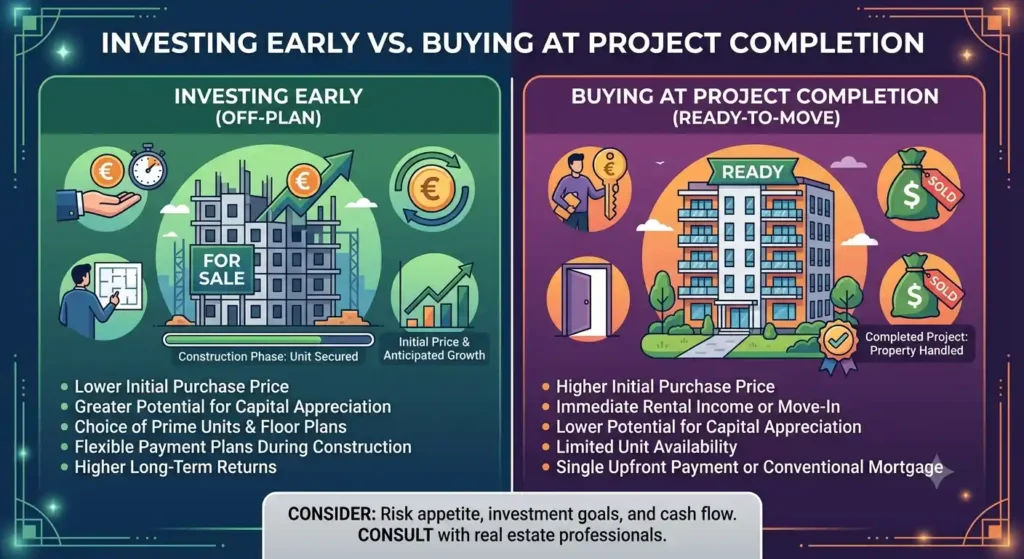
Investing Early
Advantages include:
- Introductory pricing
- Promotional offers
- Flexible installment plans
- Better affordability
- Lower initial investment
Developers commonly reward early buyers because they help generate momentum during the project’s launch.
Buying After Completion
Completed projects usually command higher market prices because:
- Construction risk has been reduced.
- Buyers can inspect the finished property.
- Immediate possession is available.
- Demand increases after successful completion.
Although prices are often higher, buyers gain confidence by purchasing a finished asset.
Capital Appreciation Potential
Property appreciation is one of the strongest reasons many investors enter projects early.
Consider a simplified example.
An apartment purchased during launch may increase in value as construction advances, infrastructure improves, and demand grows.
By project completion, early buyers may already benefit from capital appreciation.
This makes early investment particularly attractive for long-term investors.
Rental Income Opportunities
Rental income begins only when the property is ready for occupancy.
Early Investment
Advantages:
✔ Lower purchase price
✔ Higher appreciation potential
Limitations:
- Rental income starts after possession.
Completed Property
Advantages:
✔ Immediate rental opportunity
✔ Instant cash flow
✔ Faster return through monthly income
For investors seeking passive income immediately, completed properties may be more suitable.
Payment Flexibility
One of the strongest advantages of investing early is payment convenience.
Developers frequently offer structured installment plans that allow buyers to spread payments over several construction milestones.
This makes property ownership more accessible for:
- Salaried professionals
- First-time buyers
- Young investors
- Families planning future homes
Completed projects often require larger upfront payments or financing arrangements.
Risk Comparison
Every investment involves some level of risk.
Risks of Investing Early
Potential considerations include:
- Construction delays
- Market fluctuations
- Developer credibility
- Regulatory approvals
These risks can be significantly reduced by choosing an experienced and reputable developer with a strong delivery record.
Risks of Buying Completed Projects
Completed projects generally involve lower construction-related risk.
However, buyers may face:
- Higher purchase prices
- Limited unit selection
- Lower appreciation potential after purchase
Each strategy involves trade-offs rather than absolute advantages.
Choosing the Best Unit
One overlooked benefit of investing early is having access to the widest selection of units.
Early buyers often choose:
- Corner apartments
- Higher floors
- Better views
- Preferred orientations
- Larger layouts
These units frequently enjoy stronger resale value and greater rental appeal.
Buyers entering after completion usually have fewer options available.
Which Buyers Benefit Most from Early Investment?
Early investment is often ideal for:
✔ Long-term investors
✔ Young professionals
✔ Buyers with flexible timelines
✔ Families planning future homes
✔ Investors seeking capital appreciation
These buyers can benefit from both flexible payments and future price growth.
Which Buyers Should Consider Completed Projects?
Buying after completion may suit:
✔ Buyers needing immediate possession
✔ Investors seeking rental income now
✔ Families relocating quickly
✔ Buyers wanting to inspect the property before purchasing
Immediate usability is often the biggest advantage of completed developments.
Why Developer Reputation Is More Important Than Timing
Whether investing early or purchasing after completion, the developer remains one of the most important factors influencing investment success.
Before purchasing any property, buyers should evaluate:
- Previous completed projects
- Construction quality
- Legal approvals
- Customer reviews
- Delivery timelines
- Engineering standards
A trusted developer reduces uncertainty and increases buyer confidence throughout the investment journey.
How Al Rauf Group Creates Long-Term Value
At Al Rauf Group, we focus on developing structured residential environments designed for long-term value and modern living.
Al Rauf Group is contributing to this transformation through residential developments focused on:
- Affordable apartment living
- Family-friendly communities
- Flexible installment plans
- Long-term investment value
Al-Rauf Smart City
Ideal for modern apartment living with flexible installment plans.
Visit: Al-Rauf Smart City
Al-Rauf North Vista I & II
Popular for family apartments and installment-based ownership.
Visit: Al-Rauf North Vista I & II
Al-Rauf Gold Raas
Affordable residential investment opportunities.
Visit: Al-Rauf Gold Raas
Al Rauf Gold Residency
Family-oriented apartment project with modern amenities.
Visit: Al Rauf Gold Residency
China Town Residency
Modern apartment living for urban buyers.
Visit: China Town Residency
Investing Early vs Buying at Completion: Quick Comparison
| Feature | Investing Early | Buying at Project Completion |
|---|---|---|
| Purchase Price | Lower | Higher |
| Payment Flexibility | Excellent | Limited |
| Unit Selection | Wide Variety | Limited Availability |
| Rental Income | After Possession | Immediate |
| Capital Appreciation | Higher Potential | Moderate |
| Investment Risk | Moderate | Lower |
| Property Inspection | Not Immediately Available | Fully Available |
| Best For | Long-Term Investors | Immediate End Users & Rental Investors |
Final Thoughts
There is no universal answer to the question of whether investing early or buying after project completion is better.
The right decision depends on your objectives.
If your priority is maximizing capital appreciation, securing introductory pricing, and benefiting from flexible payment plans, investing early can be an excellent strategy.
If your goal is immediate possession, rental income, and reduced uncertainty, buying a completed project may be the better option.
Ultimately, successful real estate investing is not just about timing it is about choosing the right project, the right location, and the right developer.
When these three elements come together, your investment is far more likely to deliver long-term value.
Frequently Asked Questions
1. Is investing early in a real estate project better than buying after completion?
Investing early can offer lower introductory prices, flexible payment plans, and greater potential for capital appreciation. Buying after completion provides immediate possession, rental income, and the ability to inspect the finished property before purchasing.
2. What are the risks of investing in an under-construction project?
The main risks include construction delays, market fluctuations, and choosing an inexperienced developer. Buyers can reduce these risks by verifying legal approvals, reviewing the developer’s track record, and selecting projects from reputable companies with a history of successful delivery.
3. Can I earn rental income from a pre-launch property?
Rental income usually begins only after the project is completed and possession is handed over. However, investors who buy during the pre-launch phase may benefit from price appreciation before the property becomes available for rent.
4. Why do developers offer lower prices during the pre-launch phase?
Developers often introduce projects at lower introductory rates to generate early sales momentum, attract investors, and support project financing. As construction progresses and demand increases, prices are typically revised upward.
5. Which strategy is better for first-time property buyers in Karachi?
First-time buyers who want flexible installments and long-term appreciation may benefit from investing early. Buyers who need immediate possession or rental income often prefer completed projects. The best choice depends on budget, timeline, and investment goals.