
Commercial Property in Clifton Block 2, Karachi: What Investors Should Actually Know
Introduction
Quick answer: Clifton Block 2 works well for commercial investment because it already has an established population, steady foot traffic, and easy access to other major parts of Karachi. But the name “Clifton” alone doesn’t guarantee returns the specific street, building, frontage, parking, and tenant matter far more than the neighborhood. Calculate rental yield honestly (annual rent ÷ purchase price × 100), and verify commercial-use status and ownership documents before you pay anything.
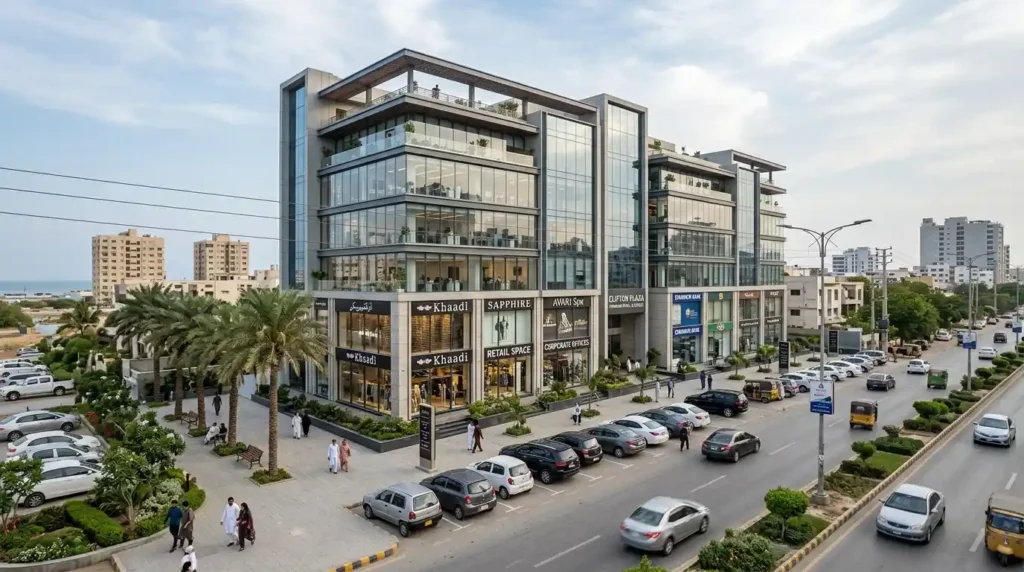
Say “Clifton” to most people in Karachi and they picture apartments, restaurants, and a certain lifestyle. What gets overlooked is that Clifton is also a working commercial hub — shops, offices, showrooms, and mixed-use buildings that serve both residents and the steady stream of people passing through.
If you’re considering commercial property in Clifton Block 2, here’s what actually decides whether it’s a good buy.
Why Clifton Block 2 Attracts Commercial Investors
Location does most of the heavy lifting in commercial real estate, and Clifton has an unusual combination going for it: dense residential communities, offices, restaurants, retail, schools, hospitals, and recreational spots, all within one established part of the city. That mix means a business here can pull from both people who live nearby and people just visiting.
The advantages worth noting:
- Infrastructure that’s already built, not still being developed
- A strong, established residential population nearby
- Direct access to major roads
- Proximity to DHA and other central areas
- Existing retail and restaurant activity
- Visibility that matters for customer-facing businesses
- Ongoing demand for professional office space
- A premium residential and lifestyle backdrop
But here’s the catch: buying “in Clifton” isn’t the same as buying a good property. The exact street, the specific building, and what’s happening commercially around it will matter far more than the area’s name on paper.
The Types of Commercial Property You’ll Find
Shops and Retail Units
These depend on walk-in traffic, so they suit cafes, restaurants, pharmacies, salons, convenience stores, boutiques, banks, phone and electronics stores, and specialty retail. A shop’s real value comes down to visibility, frontage, foot traffic, parking, and what other businesses are operating nearby — not just square footage.
Commercial Offices
Offices tend to attract consultants, law firms, real estate companies, IT businesses, marketing agencies, financial services, medical professionals, and corporate tenants. For this type of property, lift access, parking, backup power, internet reliability, and how well the building is managed matter more than they would for a shop.
Showrooms
Showroom businesses need to be seen and easy to reach. Look for wide frontage, room for good signage, convenient parking, easy road access, and strong commercial activity already happening around the property.
Mixed-Use Properties
These combine uses in one building — retail or a showroom on the ground floor, offices or apartments above, for example. They offer flexibility, but make sure every portion of the building is legally approved for the use you’re planning. A ground floor zoned for retail doesn’t automatically mean the upper floors are cleared for commercial use.
Entire Commercial Buildings
Some investors skip individual units and buy the whole building instead, which gives more control over tenancy, management, renovation, and rental strategy. It also means a much bigger upfront investment and more maintenance responsibility falling entirely on you.
The Address Matters Less Than the Exact Spot
Two properties can sit in the same block and perform completely differently. Before buying, look closely at what’s actually around the building:
- Visibility — can people see the property from the road?
- Frontage — is there enough road-facing space?
- Accessibility — can customers actually get to it easily?
- Parking — is there room for customers and staff?
- Traffic patterns — how busy is the road at different times of day?
- Neighboring businesses — what’s operating around it?
- Residential catchment — how many potential customers actually live nearby?
- Future development — is anything new planned close by that could help or hurt?
These details shape both how well you can rent it out and how easily you can sell it later.
Working Out the Rental Yield
Rental income is usually the main reason people buy commercial property, but it varies enormously from one unit to the next — a ground-floor shop with heavy foot traffic and an upper-floor office can have completely different earning potential even in the same building.
The basic formula:
Gross Rental Yield = Annual Rent ÷ Purchase Price × 100
For example: a commercial unit costing PKR 5 crore that rents for PKR 250,000 a month brings in PKR 30 lakh a year. That works out to 30 lakh ÷ 5 crore × 100 = 6%.
That’s the simplified version. Your actual return will be lower once you factor in taxes, maintenance, vacant periods, and any renovation costs — so treat the basic yield as a starting point, not the final answer.
What Kinds of Businesses Actually Do Well Here
- Food and beverage — restaurants, cafes, bakeries, and takeaway spots benefit from both residents and visitor traffic.
- Healthcare — clinics, diagnostic labs, and pharmacies find steady demand in established residential pockets.
- Professional services — lawyers, accountants, consultants, architects, and engineers need an accessible, credible office address.
- Retail — benefits directly from the nearby residential population.
- Beauty and wellness — salons, spas, and fitness studios can tap into both residents and working professionals.
- Corporate offices — companies wanting a central, recognizable business address.
The real driver of success isn’t “being in Clifton” — it’s whether the specific location and business model actually match up.
What Actually Decides the Price
There’s no fixed rate for commercial property here. What you’ll pay depends on the property’s size, exact road position, frontage, floor, building age, construction quality, parking, current rental income, tenant quality, lease terms, legal commercial status, documentation, amenities, and what’s happening commercially around it.
It’s entirely possible for a small, well-placed shop to cost more than a much larger office tucked away somewhere with poor visibility.
Commercial vs. Residential: A Quick Comparison
| Factor | Commercial | Residential |
|---|---|---|
| Potential rent | Can be higher in the right spot | Usually more predictable |
| Tenant type | Businesses | Individuals and families |
| Lease length | Often longer | Often shorter |
| Upfront investment | Can be higher | Wide range |
| Vacancy risk | Can hit hard | Also possible, but different pattern |
| Maintenance | Depends on the property | Depends on the property |
| Sensitivity to location | Very high | High |
| Risk factor | Tied to the tenant’s business success | Tied to general housing demand |
Neither type is automatically the better choice — it comes down to your budget, income goals, how long you plan to hold the property, and how much risk you’re comfortable with.
The Legal Checks You Cannot Skip
This is where a lot of commercial deals quietly go wrong. Before any serious payment:
- Confirm ownership. Know exactly who legally owns the property.
- Verify commercial status. Make sure it’s actually approved for the commercial use you intend.
- Check building approvals. Confirm the relevant permissions exist for the building and its current use.
- Check for outstanding dues — unpaid maintenance, utilities, government charges, or building fees attached to the unit.
- Review any existing tenancy — the agreement, monthly rent, security deposit, lease length, renewal terms, payment history, and who’s responsible for maintenance.
Get a property lawyer to go through all of this before you finalize anything. Verbal reassurance from a seller isn’t a substitute for paperwork.
Buying a Property With an Existing Tenant
A rented commercial property can look appealing because it’s already earning — but the tenant is what actually determines whether that income is reliable. Ask:
- Who is the tenant, and how long have they been there?
- Is rent actually paid on time?
- When does the lease end?
- Is the rent in line with the current market?
- Who covers maintenance and utilities?
- Are there any disputes on record?
A property with a stable, long-term tenant on a clean lease is a very different investment from one sitting empty and waiting for someone new.
Don’t Overlook Parking
Parking quietly makes or breaks a lot of commercial properties in Karachi. Customers avoid businesses where parking is a constant hassle. Before buying, confirm the number of spaces, whether they’re dedicated or shared, what’s available for customers versus employees, whether parking rights are actually documented, and how accessible it is during peak hours. Never assume roadside parking will always be there when you need it.
Frontage and Visibility Matter More Than Square Footage
For any retail business, being seen is half the battle. Good frontage helps with signage, brand visibility, walk-in traffic, and display space. When comparing two properties, don’t just look at total area — a smaller shop with excellent frontage can outperform a bigger one that’s harder to spot from the road.
Existing Property or New Development?
Existing commercial property gives you an established location, a track record of rental history, sometimes immediate possession, and an existing tenant already in place — which makes it easier to compare against similar properties nearby. The trade-offs: older construction, higher maintenance needs, possible tenant issues, and renovation costs.
New commercial developments offer modern construction, updated design, newer facilities, and better parking setups. The downsides: higher prices, development delays, ongoing service charges, and less certainty about how rents in a brand-new market will actually perform. Developer and documentation checks matter even more here.
A Simple Five-Step Way to Evaluate Any Property
- Know your objective. Rental income? Your own business? Long-term holding? Resale? Each answer points to a different kind of property.
- Set a realistic budget. Beyond the purchase price, factor in taxes, transfer charges, legal fees, brokerage, renovation, furnishing, maintenance, and any vacancy period.
- Compare similar properties on price per square foot, location, rental income, building quality, and parking — not just the asking price alone.
- Inspect it in person, at different times of day, to understand real traffic, noise, parking pressure, and accessibility.
- Verify every document — legal and financial — before making the final payment.
Mistakes Buyers Keep Making
- Buying purely for the Clifton name — every property still needs individual evaluation.
- Ignoring rental yield — a high price tag doesn’t guarantee high rental income.
- Focusing only on size — for many businesses, location and visibility matter more than extra square footage.
- Forgetting vacancy risk — commercial units can sit empty between tenants longer than you’d expect.
- Not checking building charges — maintenance and service fees eat directly into your net rental income.
- Ignoring tenant quality — a rented property is only as reliable as the lease and tenant behind it.
- Skipping legal verification — never rely on verbal assurances about ownership or commercial status.
Is It Worth It for the Long Term?
For investors thinking long-term, established locations like Clifton Block 2 do offer real advantages: built-out infrastructure, existing residential demand, active commercial life, solid road connectivity, and a working business ecosystem already in place.
That said, none of this guarantees future appreciation across the board. Evaluate each property on its own rental economics, legal standing, building condition, and what’s developing around it — don’t assume every commercial unit here will perform the same.
Investment Checklist
Property: Is the location suitable? Is it legally approved for commercial use? Is the size accurate? Is the building well maintained?
Income: What rent is realistically achievable? Is there a current tenant? What does the existing lease say? What vacancy period should you expect?
Costs: What are the taxes? What are the maintenance charges? Does it need renovation? What are the total transaction costs?
Location: Is parking available? Is visibility good? Is access convenient? What businesses operate nearby?
Legal: Is ownership clear? Is the documentation complete? Are there outstanding dues? Any disputes on record?
Final Thoughts
Commercial property in Clifton Block 2 can be a solid investment, but only if you look past the neighborhood’s reputation and evaluate the specific property in front of you. Location, visibility, accessibility, parking, rental income, tenant quality, building condition, legal status, and documentation all deserve real scrutiny — not just a glance at the asking price.
Compare the total cost of ownership against realistic income potential before you commit. And if you’re serious about investing here, compare multiple properties, walk through them yourself, and complete proper legal due diligence before signing anything.
FAQ
What types of commercial property are available in Clifton Block 2? Shops, offices, showrooms, mixed-use buildings, and larger commercial properties are all available, depending on current listings and each property’s approved legal use.
Is commercial property in Clifton Block 2 a good investment? It can be, but returns vary widely by location, property type, purchase price, tenant demand, and running costs. Each property needs to be evaluated on its own, not judged by the area alone.
What affects commercial property prices in Clifton Block 2? Size, exact location, frontage, road visibility, floor, parking, building condition, current rental income, tenant quality, documentation, and nearby commercial activity all play a role.
Can I buy a commercial property that already has a tenant? Yes. Before buying, review the existing lease, rent payment history, security deposit, tenant background, and the terms of transfer.
How do I calculate rental yield on commercial property? Divide the annual rental income by the purchase price and multiply by 100 to get the gross yield. Subtract taxes, maintenance, and expected vacancy periods to get a more realistic net figure.
What legal documents should I verify before buying? Ownership and transfer records, proof of commercial-use approval, relevant building permissions, any outstanding dues, and tenancy documents — ideally reviewed by a property lawyer.
Does parking really matter for commercial property in Clifton? Yes — it affects customer convenience, tenant interest, and how usable the property actually is day to day. Confirm exactly what parking rights come with the sale.
Should I invest in a shop or an office? It depends on your budget, expected rental income, and the type of tenant you’re targeting. Shops suit customer-facing businesses; offices tend to attract professional and corporate tenants.