Cash vs Bank Financing for Property Purchase in Pakistan
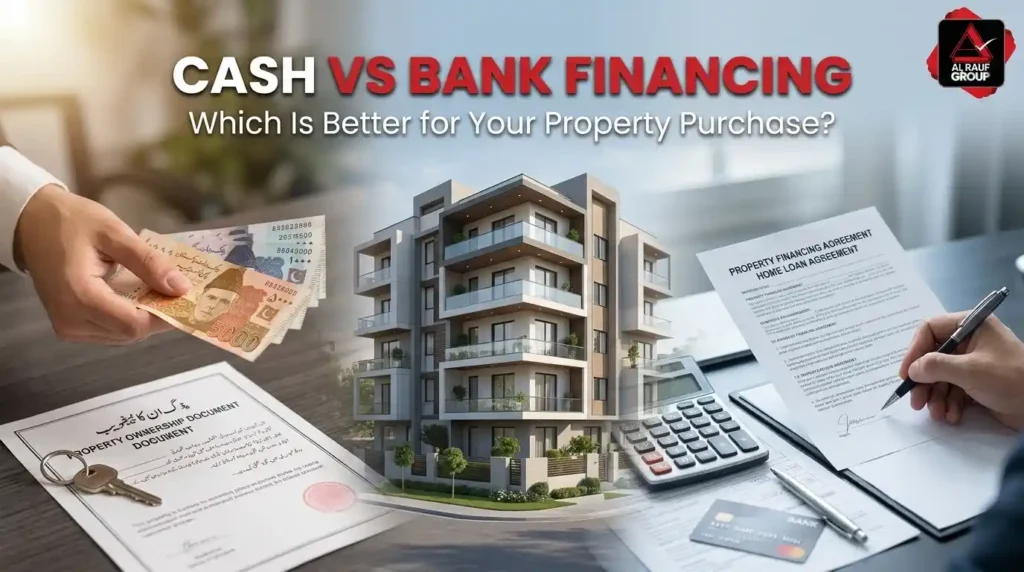
Cash vs Bank Financing for Property Purchase: Which Should You Choose?
You've found the right apartment. The location works, the layout suits your family, and the price feels fair. Then the real question lands: do you pay it all upfront, or let a bank help? Here's a plain-English look at both options, what they actually cost, and how to pick the one that lets you sleep at night.
Is It Better to Buy Property With Cash or Bank Financing?
Short answer: Pay cash if you can afford the property and still keep a healthy emergency fund. Choose bank financing if you have steady, verifiable income, can comfortably handle the monthly instalments, and want to hold on to your savings. Cash costs less overall. Financing keeps you more liquid.
That's the quick version, but the right choice rarely comes down to the money in your account today. Your income, upcoming expenses, family plans and how much risk you're comfortable with all matter just as much.
The 30-second summary
- Cash: no instalments, no financing charges, simpler process. But your savings can drop sharply.
- Bank financing: smaller upfront payment and better cash flow. But you repay more than the property price over time.
- The deciding factor: not "which is cheaper?" but "which one can I live with comfortably for years?"
What Does It Mean to Buy Property With Cash?
Buying with cash means paying the full agreed price from your own funds, with no housing loan involved. Once payment and transfer formalities are done, there's no bank instalment to worry about.
Say an apartment costs PKR 15 million and you have the funds ready. You pay, complete the paperwork, and the property is yours without a lender in the picture.
What are the benefits of paying cash for a property?
No monthly instalments
Your household budget stays simple. No repayment date to remember each month.
Lower total cost
You skip financing charges that can add up significantly over the years.
Less paperwork
No loan application, bank assessment or financing documents to wait on.
More freedom
No repayment schedule tying your hands as you manage or use the property.
What are the downsides of a cash purchase?
Paying in full feels safe, but it isn't risk-free. Watch out for these:
- It can swallow a big share of your savings.
- Emergencies, repairs or family expenses become harder to cover.
- That money can't be used for other opportunities, like a business.
- You must arrange the whole amount before the deal can close.
A friendly warning: Don't empty your account for the sake of "no loan." Keep money aside for household costs, emergencies, taxes and maintenance. Being property-rich but cash-poor is stressful.
How Does Bank Financing Work for Buying a Property?
With bank financing, you pay an initial amount (the down payment) and the bank funds the rest, subject to its valuation, your eligibility and approval. You then repay the bank in instalments over an agreed period.
Using the same PKR 15 million apartment, you might put in PKR 5 million from your savings and apply for the remaining PKR 10 million. Whether you get it depends on your income, credit history and the property itself.
In Pakistan, housing finance is offered through both conventional banking and Islamic banking products. They're structured differently, so read the agreement carefully before you sign anything.
What are the benefits of bank financing?
Smaller upfront payment
You don't need the full price on day one, depending on the bank's limit.
Healthier cash flow
Keep savings for emergencies, your business or other commitments.
Own a home sooner
No need to wait years until you've saved the entire amount.
Predictable planning
A repayment schedule lets you build your monthly budget around it.
What are the downsides of bank financing?
- Monthly repayments are a long-term commitment, whatever happens to your income.
- Financing charges raise the total cost of the property.
- Some products have variable rates, so payments can change.
- Approval depends on your income, credit assessment and the property's eligibility.
- Valuation, legal, documentation and other bank charges may apply.
- Missed repayments can lead to financial and legal trouble.
Cash vs Bank Financing: What Are the Key Differences?
The biggest differences are upfront cost, monthly obligations and total price paid. Cash costs more today but less overall. Financing costs less today but more over time.
| Factor | Cash Purchase | Bank Financing |
|---|---|---|
| Initial payment | Full property price | Down payment plus applicable costs |
| Monthly instalments | None | Regular repayments |
| Financing charges | Not applicable | As per the agreement |
| Your savings | Can drop significantly | More of it stays available |
| Approval | No bank approval needed | Bank assessment required |
| Ongoing commitment | Low | Long-term repayment obligation |
| Best for | Buyers with ample funds | Buyers with stable repayment capacity |
What Does a PKR 15 Million Property Look Like Under Each Option?
Numbers make this easier to picture. Here's a simple, illustrative example for an apartment priced at PKR 15 million.
Illustrative property value
You pay the full price from your own funds. No loan, no instalments.
Illustrative down payment, with PKR 10M sought from a bank and repaid over time.
The catch with option 2: you'll likely pay more than PKR 15 million by the end, because of financing charges, fees and other costs. Your actual instalment depends on the approved amount, the rate or profit structure, the repayment period and the bank's terms.
Keep in mind: This example is for comparison only, not a bank quotation. Always request a written offer with the full cost breakdown.
What Are the Housing Finance Rules in Pakistan?
The State Bank of Pakistan (SBP) issued revised Prudential Regulations for Housing Finance on 18 August 2026. They allow a maximum tenor of 30 years, a maximum loan-to-value ratio of 90:10, and cap total monthly amortisation at 65% of net disposable income.
Maximum tenor: 30 years
The longest possible repayment period, subject to conditions and bank policy.
Loan-to-value: 90:10
A regulatory ceiling, not a promise. Many buyers will be offered less.
Debt burden: 65%
Total monthly amortisation can't exceed 65% of your net disposable income.
Bank assessment
Banks review your income, repayment capacity, credit record and property papers.
These are upper limits, not entitlements. Each bank sets its own eligibility criteria, risk checks and product terms. Before applying, read the official SBP revised housing finance regulations.
What's the difference between conventional and Islamic housing finance?
Conventional products usually follow an interest-based structure. Islamic products use Shariah-compliant arrangements such as Diminishing Musharakah. Both can fund a home, but their contracts work differently.
Whichever you consider, don't compare on the advertised monthly payment alone. Look at the rate or profit mechanism, fees, payment schedule and early settlement terms.
Which Option Is Right for Your Situation?
There's no universal winner. Choose cash if paying in full still leaves you with a solid safety net. Choose financing if your income is stable and the instalments sit comfortably inside your budget.
Go with cash if…
- You have the funds available.
- You'll still keep emergency savings.
- You want to avoid financing charges.
- You prefer fewer long-term obligations.
- You don't need the money for other big goals.
Consider financing if…
- Your income is stable and verifiable.
- Instalments fit comfortably in your budget.
- You want to preserve personal savings.
- You understand the total financing cost.
- You qualify for a suitable product.
What Should You Check Before Buying a Property?
Cash or loan, run through these seven points before you commit.
Set your total budget
Count the price plus every extra expense.
Protect your savings
Keep an emergency fund instead of spending it all.
Compare offers
Review rates, profit structures, fees and tenors.
Test the instalment
Make sure it fits your regular household budget.
Verify documents
Check ownership, approvals, title and transfer requirements.
Add up extra charges
Include taxes, transfer fees, valuation and legal costs.
Think ahead
Consider income changes, family needs and long-term plans.
What Are the Most Common Property Buying Mistakes?
Most buyers fixate on the sticker price and miss the details around it. Avoid these:
- Spending all your savings on a cash purchase.
- Accepting a bank offer without checking the total repayment cost.
- Picking a very long tenor without seeing what it does to overall cost.
- Ignoring the chance that variable rates may rise.
- Skipping checks on ownership and legal status.
- Forgetting transfer taxes, maintenance and other charges.
- Deciding just because friends or family did it a certain way.
A good purchase isn't just about getting the keys. It's about owning a home you can afford to live in, and keep, for years.
Final Thoughts: Choose the Option You Can Live With
Cash gives you simplicity and freedom from repayments. Bank financing gives you access and flexibility with your savings. Neither is "right" on its own. The better one is the one that matches your finances and leaves you confident, not stretched.
Before deciding, compare the complete purchase cost, read the financing terms line by line, and confirm the property's legal documents. If you're unsure, speak to a bank, financial adviser or legal professional.
At Al Rauf Group, we believe informed buyers make better decisions. Keep exploring our property insights whenever you're planning your next move.
Keep Reading
Frequently Asked Questions
Is it better to buy property with cash or bank financing?
Cash is better if you can afford the full price and still keep enough savings. Bank financing suits buyers with stable income who can manage monthly repayments and want to preserve their funds.
Can I buy an apartment through bank financing in Pakistan?
Yes. Eligible buyers can get housing finance for an apartment, subject to the bank's eligibility criteria, property valuation, legal documentation and applicable regulations.
How much down payment is required for property financing in Pakistan?
It depends on the bank, the product and the property valuation. Under the SBP framework revised in August 2026, the maximum loan-to-value ratio is 90:10, but that doesn't guarantee every buyer 90% financing.
Does bank financing increase the total cost of a property?
Yes. Interest or profit payments and applicable fees mean you repay more than the property price. The exact amount depends on the structure, repayment period, rate and bank charges.
Can I buy property in cash without taking a loan?
Yes. You can buy with your own funds. Still verify ownership documents, payment records, taxes and the legal transfer process.
What is the maximum housing finance period in Pakistan?
Under the SBP regulations revised on 18 August 2026, the maximum tenor is 30 years. Your actual period depends on the bank's policies and your eligibility.
Is Islamic financing available for property purchases in Pakistan?
Yes. Several Islamic banking products use Shariah-compliant structures such as Diminishing Musharakah. Read the agreement and payment obligations carefully before choosing one.
What should I check before choosing bank financing?
Compare total financing cost, monthly instalment, repayment period, rate or profit mechanism, processing fees, insurance requirements, early settlement terms and property eligibility.
Ready to Find Your Next Property?
Explore Al Rauf Group for real estate opportunities and practical buying resources, so your next decision feels like a confident one.
Explore Al Rauf Group →