
Office vs Retail Space: Which Commercial Property Should You Choose?
Introduction
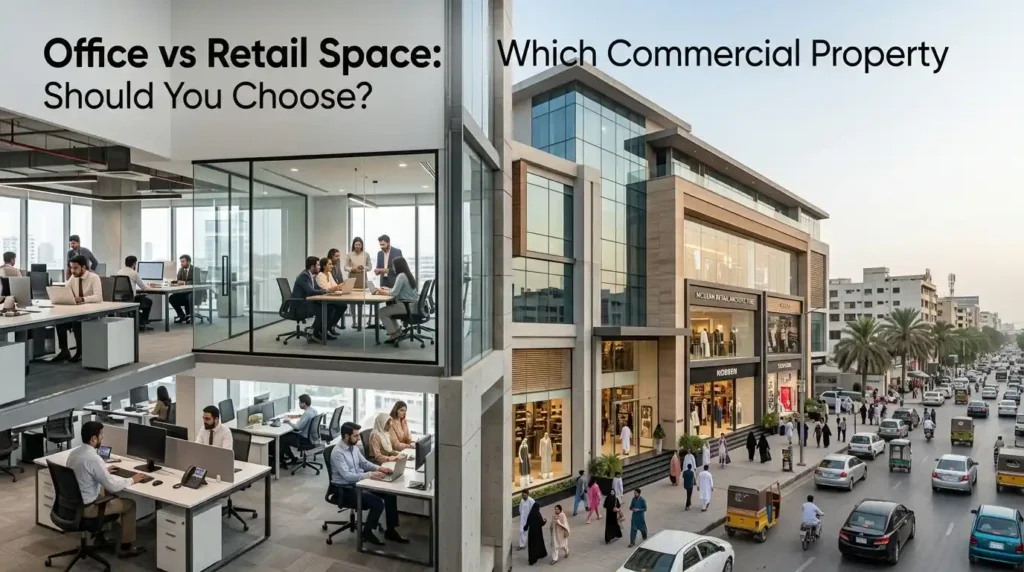
Neither one is “better.” Office space usually works best for professionals and companies who need an accessible, business-friendly location. Retail space usually works best when a property has high visibility, heavy foot traffic, and easy parking. The right choice depends on your budget, your goals, and who you expect to rent from you.
Buying commercial property is a big decision, and office and retail space are the two options most people compare first. Both can earn rent. Both can grow in value over time. But they don’t work the same way, and they don’t attract the same kind of tenant.
This guide breaks down the real differences in plain language, so you can decide which one fits your goals.
What Is an Office Space?
An office space is built for people who run a business, not people who walk in to buy something.
Common office tenants include:
- Corporate teams and startups
- IT and software companies
- Law firms and consultants
- Accounting and marketing firms
- Real estate agencies
- Freelancers and small professional practices
Office property can be one small room or a whole floor of a building. What drives its value is usually location, ease of access, building quality, parking, security, and how close it is to a recognized business area.
What Is a Retail Space?
Retail space is built for businesses that need customers to physically show up.
Common retail tenants include:
- Clothing shops and supermarkets
- Restaurants and cafés
- Pharmacies and electronics stores
- Furniture showrooms
- Salons and mobile phone shops
- Branded outlets
Retail depends far more on visibility and footfall than office space does. A small shop on a busy road can easily outperform a bigger shop stuck somewhere quiet.
Office vs Retail: The Main Differences at a Glance
| Factor | Office Space | Retail Space |
|---|---|---|
| Main purpose | Running a business | Selling to customers |
| What location needs to offer | Easy access | Visibility and foot traffic |
| Typical tenant | Companies, professionals | Retailers, service businesses |
| Customer footfall | Usually low | Often high |
| Parking | Important | Extremely important |
| Fit-out cost | Moderate to high | Often high |
| Rent demand driven by | Business district strength | Exact location and traffic |
| Tenant turnover | Often more stable | Can swing a lot |
| Visibility | Matters | Critical |
| Investment style | Steady income | Higher upside, higher risk |
| Best fit for | Corporate/service businesses | Customer-facing businesses |
1. Location Matters for Both — Just Not the Same Way
For office space, tenants care about easy access from main roads, closeness to business districts, public transport, parking, and a professional building. An office doesn’t need to sit on the busiest street in town — it just needs to be easy to reach and located in a recognized commercial zone.
For retail space, visibility is everything. A shop needs to be seen from the road, reachable on foot and by car, and surrounded by the right kind of population — enough people walking or driving past who might actually walk in.
Bottom line: office needs accessibility, retail needs to be seen.
2. Which One Pays Higher Rent?
There’s no fixed rule here — rent depends on location, size, building quality, floor, parking, and demand, not just whether it’s “office” or “retail.”
A well-located office can bring in steady, reliable rent. A prime retail shop can sometimes charge more, because businesses are willing to pay extra for visibility and customer access. But a badly placed shop can easily earn less than a decent office — so don’t assume retail always wins on rent. It doesn’t.
3. Which Tenants Stay Longer?
Office tenants especially established companies tend to stay for years if the space and location suit them.
Retail tenants come and go more easily. How long a shop tenant stays usually depends on:
- Their sales performance
- Foot traffic
- Competition nearby
- Rent levels
- The type of business
- Seasonal ups and downs
So when comparing tenants, look at the specific business and location not just the property category.
4. Setup Costs: Office vs Retail
Office fit-out usually includes partitions, flooring, lighting, workstations, meeting rooms, a reception area, internet setup, AC, and security systems.
Retail fit-out usually includes display areas, shelving, signage, special lighting, branding, storage, security, interior design, and (for food businesses) kitchen equipment.
Retail fit-outs are often more expensive, because the space has to look good enough to attract and hold customers not just function well internally.
5. Parking Matters for Both But Differently
Office staff stay for hours, so convenient, reliable parking matters a lot.
Retail customers usually stop by quickly. If parking is a hassle, they’ll often just go somewhere else. Before buying retail property, check dedicated and street parking, traffic flow, entry and exit points, and loading access. For office property, check the parking-to-space ratio and how easily staff and visitors can get in.
6. Will the Property Grow in Value?
Both office and retail properties can appreciate as the area around them develops better roads, new housing nearby, more businesses, improved amenities. Neither type has an automatic advantage here.
Instead of asking “is this office or retail,” a sharper question is:
“Why would demand for this exact property increase in the future?”
That question forces you to look at real fundamentals instead of relying on labels.
7. Which Resells More Easily?
Resale value comes down to location and fundamentals, not category.
A retail unit in a strong commercial area can attract several types of buyers. So can an office in an established business district investors, companies, professional firms, and rental-focused buyers. Properties with flexible potential uses are usually easier to sell later.
8. Office Space Fits Best If You Run a Service-Based Business
If you’re buying for your own company, office space usually makes more sense for:
- Construction and engineering firms
- Software companies
- Marketing agencies
- Financial services and consultants
- Legal and corporate offices
A good office can also improve staff productivity and how clients perceive your brand.
9. Retail Space Fits Best If Customers Need to Walk In
Retail is the better choice when your business depends on people physically showing up restaurants, clothing stores, supermarkets, pharmacies, salons, electronics shops, and furniture stores. For these, visibility and easy access aren’t nice-to-haves they directly affect how much money the business makes.
10. Risk: Office vs Retail
Office risks: shifting demand for office space, remote/hybrid work trends, longer vacancy periods, maintenance costs, limited parking, dependence on one business district.
Retail risks: changing shopping habits, competition, weak footfall, higher tenant turnover, business closures, expensive fit-outs.
Every commercial property carries risk. The best protection is doing proper due diligence before you buy not picking one category because it “sounds safer.”
What to Check Before Buying Any Commercial Property
Whether you go office or retail, check these before signing anything:
Legal documents Ownership papers, title and transfer records, approved building plans, authority approvals, commercial status, NOCs, outstanding dues, property tax, and utility connections.
Location Road access, traffic patterns, parking, nearby development, public transport, surrounding businesses, nearby population, and planned future infrastructure.
Rental demand Current rental rates, vacancy levels, typical tenant profile, lease terms, and historical rent trends in the area.
The building itself Construction quality, elevators, backup power, water supply, fire safety, security, maintenance standards, common areas, and parking facilities.
Office or Retail — Which Should You Actually Choose?
Go with office space if:
- You want professional or corporate tenants
- The area has strong office demand
- You’re buying in an established business district
- Building amenities and accessibility matter to you
- You’re buying for your own service-based business
Go with retail space if:
- The location has strong visibility
- The area has real, consistent foot traffic
- Parking is convenient
- You want exposure to customer-facing businesses
- The surrounding commercial activity is already established
What About Mixed-Use Properties?
Mixed-use projects combine retail, offices, apartments, restaurants, and sometimes entertainment or community spaces in one development. The appeal is that each part feeds the others residents and office workers create customers for the shops, and retail makes the whole place more convenient to live and work in.
Even so, evaluate a mixed-use project the same way you would any other: location, developer track record, approvals, construction quality, management, payment plan, rental demand, and resale potential.
5 Questions to Ask Before You Buy
- What’s your goal? Own business, rental income, long-term growth, or a quick resale?
- Who’s your target tenant? Picture the exact type of business that would rent this space.
- Does the location actually support that tenant? Retail needs customers. Office needs accessibility and a professional setting.
- What’s your real total budget? Include taxes, transfer costs, renovation, maintenance, service charges, vacancy periods, and financing not just the sticker price.
- What’s your exit plan? Think about how easily you could rent or sell this property a few years from now.
Bottom Line: Office or Retail?
There’s no universal winner. Office space tends to suit investors chasing professional tenants and steady income in an established business district. Retail space tends to suit investors chasing higher upside in a location with real visibility, footfall, and demand.
What matters most isn’t the label it’s the location, the tenant demand, the numbers, the legal paperwork, and where the area is headed. A great location with solid fundamentals will always beat a property picked just because it’s “office” or “retail.”
If you’re looking at commercial property in Karachi, evaluate the whole picture location, planning, accessibility, infrastructure, and long-term potential before committing.
Frequently Asked Questions
Is office space or retail space a better investment?
Neither is automatically better. Office space usually suits investors who want steady tenants and predictable income. Retail space usually suits investors chasing higher returns in a location with strong footfall — but it also carries more risk.
Does retail space always earn more rent than office space?
No. A prime retail location can command higher rent, but a poorly located shop can easily earn less than a well-placed office. Rent depends on location, demand, and building quality not category alone.
What matters most for retail property?
Visibility and foot traffic. If people can’t see the shop or can’t easily park and walk in, sales usually suffer.
What matters most for office property?
Accessibility. Offices don’t need to be on the busiest road, but they need to be easy to reach and sit within a recognized business area.
Which is riskier, office or retail?
Both carry different risks. Offices are exposed to shifts like remote work and longer vacancies. Retail is exposed to changing shopping habits, competition, and higher tenant turnover. Neither is risk-free.
Can one property work as both office and retail?
Some mixed-use buildings combine both, along with housing or entertainment space. These can work well, but they still need to be evaluated on location, developer reputation, and rental demand like any other property.
What should I check before buying commercial property?
Ownership and title documents, approvals and NOCs, outstanding dues, location and traffic access, parking, current rental rates and vacancy levels, and the building’s construction quality and safety systems.
How do I decide between office and retail for my own business?
Ask what your customers need. If they need to walk in and buy something, go retail. If your work is service-based and clients don’t need to visit in person, an office usually makes more sense.