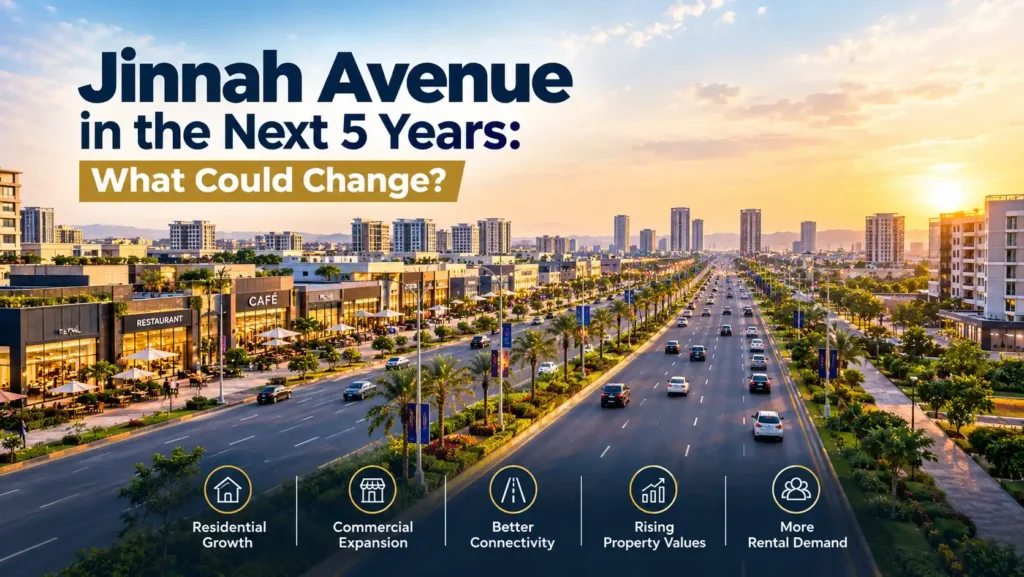
Jinnah Avenue in the Next 5 Years: Future Growth & Property Outlook
Introduction
A building rarely tells the whole story about a piece of real estate. It’s usually the roads, the shops that grow up around them, the schools, the traffic, the people moving in that’s what turns an ordinary address into somewhere people actually want to be.
Jinnah Avenue in Bahria Town Karachi is worth a closer look through that lens.
It’s already one of the standout pieces of infrastructure in the community Bahria Town describes it as a 400-foot-wide, 18-lane avenue built to move people across the development and out toward the M-9 Motorway. That’s a lot of road. But the more interesting question isn’t how wide it is today. It’s what it might turn into by 2031.
Between now and then, a handful of things could shape its trajectory how fast homes get occupied, how much gets built, how commercial activity spreads, how connectivity improves, and how buyer appetite shifts. None of that is guaranteed. Real estate never moves in a straight line interest rates, policy changes, construction delays and plain old market sentiment all get a vote. But given the scale of what’s already there, Jinnah Avenue is a reasonable place to start asking “what if.”
So What Exactly Is Jinnah Avenue?
It’s the main boulevard cutting through Bahria Town Karachi, and it functions as one of the community’s primary arteries both for getting around and for future development.
What sets it apart is sheer scale. At 400 feet wide across 18 lanes, it’s among the largest avenues built by any private housing society in Pakistan. But the width is really just the headline. What matters more is what it connects: residential precincts, commercial pockets, amenities, and through its link to the M-9 the rest of the city beyond Bahria Town’s gates.
Think of it less as a road and more as a corridor with real estate potential built in. As the areas around it fill in, it has room to become a hub for homes, shops, restaurants, cafes, offices, hotels, rental units, and mixed-use buildings the full range of what a maturing township eventually needs.
Why Might It Get More Important by 2031?
A wide road on its own doesn’t do much. What makes a road valuable is what shows up around it residents, businesses, footfall. Bahria Town Karachi is planned as a fairly self-contained township, with residential, commercial, educational, medical and recreational elements spread across a large number of precincts. That’s the backdrop that could push Jinnah Avenue from “impressive infrastructure” to “actual economic spine.”
Two forces are doing most of the work here.
More people moving in. As homes get finished and occupied, everyday demand follows naturally groceries, pharmacies, clinics, schools, salons, banks, gyms, restaurants. That kind of demand is what slowly turns a quiet residential stretch into something busier and more mixed-use.
A construction cycle that feeds itself. More infrastructure tends to encourage more building. More building means more housing. More housing brings more residents. More residents create more demand for commercial services. And that demand, in turn, makes the surrounding land more attractive to develop further. If that cycle keeps running along Jinnah Avenue, the market around it could look meaningfully more established five years from now.
Five Changes Worth Watching Over the Next Five Years
1. More commercial activity. The avenue’s sheer width makes it a natural fit for larger commercial and mixed-use projects high visibility, easy access, plenty of parking, big traffic numbers. As the precincts around it fill up, that combination tends to attract businesses. Early on, that usually means smaller shops and services; later, it can mean bigger restaurants, offices and retail destinations. Expect demand for commercial plots and shopfronts along the avenue to build gradually rather than all at once.
2. More homes going up nearby. Areas along or close to Main Jinnah Avenue Precinct 17 and Precinct 30, for instance are already tied to residential development. As more of these homes get built, the avenue increasingly becomes the main access route for a larger population, which loops back into the same cycle: more residents, more services, more businesses, more commercial demand.
3. A growing premium on well-located property. Not every plot in a large township performs the same. Proximity to boulevards, schools, hospitals, parks, entry points and transport links tends to draw a different class of buyer and tenant. A 2026 listing for a plot in Precinct 29, for example, already leans on its closeness to Jinnah Avenue as a selling point. That said, being “near” the avenue isn’t a guarantee of anything plot size, development status, documentation and actual demand still matter far more than the address alone.
4. Better connectivity raising its strategic value. Jinnah Avenue’s link to the wider road network and especially to the M-9 is one of its biggest long-term advantages. Bahria Town has designed its road network to connect residential zones, commercial hubs and medical facilities, with the M-9 interchange tying the whole thing to the motorway. Any improvement over the next five years better traffic management, added interchanges, easier access to job centers could make the avenue more appealing to residents and investors alike. Simply put: connectivity drives accessibility, and accessibility drives demand.
5. A more mature rental market. More families moving in doesn’t just mean more buyers it means more renters too. Expect rising demand for villas, apartments, furnished units and even staff accommodation, particularly near commercial stretches and major roads. Bahria Apartments in Precinct 19, already operational along Main Jinnah Avenue, is one early example of what a more built-out rental market here could look like.
Could It Actually Become a Major Commercial Hub?
It’s possible but it would happen in stages, not overnight.
Commercial hubs typically need three things to align: enough people nearby, easy access for them to get there, and enough spending power to support businesses once they show up. Jinnah Avenue has a structural edge here because it sits inside a large planned community rather than standing alone. As occupancy rises, so does the pool of potential customers, which could gradually support a broader mix of restaurants, cafes, retail, offices, banks, clinics, gyms, showrooms and supermarkets along the corridor. How fast and how far that goes will come down to actual demand, not projections.
What About Prices?
The honest answer: prices could rise if population growth, infrastructure, connectivity and commercial activity keep strengthening but none of that is locked in.
What could push prices up:
- A growing resident base
- Better roads and utilities
- Expanding commercial activity
- Improved links to the wider road network
- A genuinely limited supply of prime frontage
- More plots actually getting built on, rather than sitting vacant
What could hold things back:
- Broader economic conditions inflation, interest rates, currency swings can all squeeze buying power
- The simple fact that master-planned communities take years to mature, and unevenly across different sections
- Liquidity a property can look good on paper without being easy to actually sell
- Regulatory shifts around taxation or development approval
- Oversupply, particularly on the commercial side, where too much space chasing too few tenants can weigh on both rents and resale value
Is Commercial Property Here Worth More by 2031?
Possibly commercial real estate lives and dies by visibility, access and footfall, and Jinnah Avenue offers all three in theory. But “on Jinnah Avenue” isn’t a specific enough claim to invest on. A shop with direct frontage on the avenue is a different asset than one a few streets back. Before buying, it’s worth actually checking frontage, road width, plot size, parking, nearby population density, existing competition, development status and possession the things that determine whether a location works as a business address, not just a piece of land with a good name attached.
And Residential Property Nearby?
Being close to a major avenue helps with access, but it’s not automatically a selling point for everyone some buyers want to be right on the action, others want quiet. The sweet spot for many residential buyers is being close enough to benefit from the avenue without living directly on top of it. That’s really an argument for looking at the specific precinct rather than buying on the strength of “near Jinnah Avenue” alone.
It’s Bigger Than One Road
Jinnah Avenue doesn’t exist in isolation its future is tied to how the rest of Bahria Town Karachi develops. The community is described as a large gated township with numerous precincts and a broad mix of residential, commercial and institutional areas, and Bahria Town’s own approach leans heavily on integrated master planning. If that keeps maturing, the avenue’s role as a central connector should only grow.
Worth watching too: Bahria Town Karachi 2, where a similarly large avenue is reportedly planned using the same design concept. New developments and roads outside the current boundary can shift traffic patterns and priorities inside it so it’s worth keeping an eye on the wider M-9 corridor, not just one precinct in isolation.
2026 vs. 2031, Side by Side
| Factor | Now (2026) | Possible by 2031 |
|---|---|---|
| Residential occupancy | Still filling in | Noticeably higher |
| Commercial activity | Concentrated in pockets | More spread out and varied |
| Retail demand | Developing | Stronger |
| Rental market | Just emerging | More established |
| Infrastructure | Solid in key areas | More joined-up |
| Property demand | Depends heavily on location | Stronger around active hubs |
| Investor interest | Long-term focused | Broader |
| Role of the avenue | Main internal corridor | Bigger commercial and residential spine |
Worth repeating: these are scenarios, not promises.
Is It Actually a Good Long-Term Bet?
For someone with patience, Jinnah Avenue is at least worth studying closely. It’s got the road infrastructure, the position inside a planned community, the M-9 link, and a growing population base to draw on. But bigger road names don’t automatically mean better investments. What actually matters is the combination location, development status, real demand, accessibility, price, and how easy it’ll be to exit later. That means doing the legwork rather than buying on the strength of a name.
A few things worth checking before buying anywhere near it:
- Where the property actually sits on the master plan not just the marketing description
- Whether roads, electricity, water and sewerage are actually functional
- Possession status, verified directly with the developer or authority
- Clean ownership, allotment and transfer paperwork
- What’s genuinely built up around the property today
- For commercial plots actual foot traffic and existing businesses nearby
- Realistic rental income, not projected figures
- How easily comparable properties are actually selling, not just listing prices
- The full cost picture development charges, transfer fees, construction, taxes
- Your own timeline this is a corridor that rewards patience more than quick flips
Who Stands to Gain the Most?
- Long-term investors who can hold through the slower early years
- Commercial buyers eyeing shops, offices or plots as population and spending grow
- Families building homes who value proximity to major roads and amenities
- Rental investors, provided they track occupancy and new supply closely
- Retailers and service businesses looking to plant a flag near a growing residential base
Picture It in 2031
More finished homes lining the precincts. More families actually living there full-time. Restaurants staying open later. Shops running through the day instead of sitting half-empty. Cafes competing for the same customers. Commercial buildings filling up. A rental market with enough tenants to actually support it. Traffic that feels like a working city, not a construction site.
That’s one plausible version of where this goes. And the biggest transformation probably won’t be the road itself it’ll be everything that eventually grows up around it.
Conclusion
Jinnah Avenue is worth watching closely through 2031. Its scale, its position inside Bahria Town Karachi, and its connection to the surrounding road network give it real long-term potential. But none of that turns appreciation into a certainty — the actual payoff depends on whether the surrounding community keeps moving from construction to occupancy, and from occupancy to genuine economic activity.
So instead of asking “will Jinnah Avenue go up in value,” the sharper question is: which specific spots around it are best positioned to benefit as the population, infrastructure and commercial base keep growing? That’s the question that actually leads somewhere useful.
Frequently Asked Questions About Jinnah Avenue
1. What is Jinnah Avenue?
Jinnah Avenue is a major boulevard in Bahria Town Karachi. Bahria Town describes it as a 400-foot-wide, 18-lane avenue connecting major parts of the development and providing access toward the M-9 corridor.
2. What could happen to Jinnah Avenue in the next 5 years?
Between 2026 and 2031, Jinnah Avenue could experience greater residential occupancy, commercial activity, construction, rental demand and traffic as surrounding areas mature. The extent of these changes will depend on actual development, economic conditions and market demand.
3. Is Jinnah Avenue a good location for property investment?
Jinnah Avenue can be an attractive location for long-term property investors because of its scale, connectivity and position within Bahria Town Karachi. However, investment suitability depends on the exact property, price, development status, documentation, demand and investment timeframe.
4. Could property prices near Jinnah Avenue increase?
Property prices could increase if population, infrastructure, commercial activity and demand continue to grow. However, future appreciation is never guaranteed, and investors should not base decisions solely on projected price increases.
5. Will Jinnah Avenue become a major commercial area?
It has the potential to become a stronger commercial corridor as surrounding residential areas become more populated. Increased customer demand could support restaurants, retail, offices, services and other businesses.
6. Is Jinnah Avenue suitable for commercial investment?
Potentially. Commercial properties benefit from accessibility and visibility, both of which can be important along a major avenue. Investors should nevertheless evaluate frontage, customer traffic, parking, nearby population, competition, rental demand and the exact location before purchasing.
7. How important is connectivity for Jinnah Avenue?
Connectivity is one of Jinnah Avenue’s major advantages. Its position within Bahria Town Karachi and relationship with the M-9 road network can support accessibility to the wider metropolitan area.
8. Should I buy a plot on Jinnah Avenue now or wait?
There is no universal answer. Buying earlier may provide exposure to future development, but waiting can provide more information about actual occupancy and commercial activity. Buyers should compare today’s price with the property’s development status, expected demand and their investment horizon.
9. What should I check before buying property near Jinnah Avenue?
Check the exact location, ownership documents, possession, development status, utilities, road access, nearby construction, commercial activity, rental demand, resale liquidity and all additional purchase and development costs.
10. What is the biggest factor that could influence Jinnah Avenue’s future?
The most important factor may be the transition from infrastructure development to actual population and economic activity. A major road becomes significantly more valuable when homes, businesses, services and customers begin using the surrounding area at scale.