
Apartment Communities vs Standalone Buildings: Which Is Better for Families?
Introduction
Picking a home for your family is never just about square footage or the price tag. You’re also weighing security, privacy, parking, maintenance, whether there’s anywhere for the kids to play, and how the whole place feels to actually live in.
One of the bigger decisions along the way is whether to go for a planned apartment community or a standalone building.
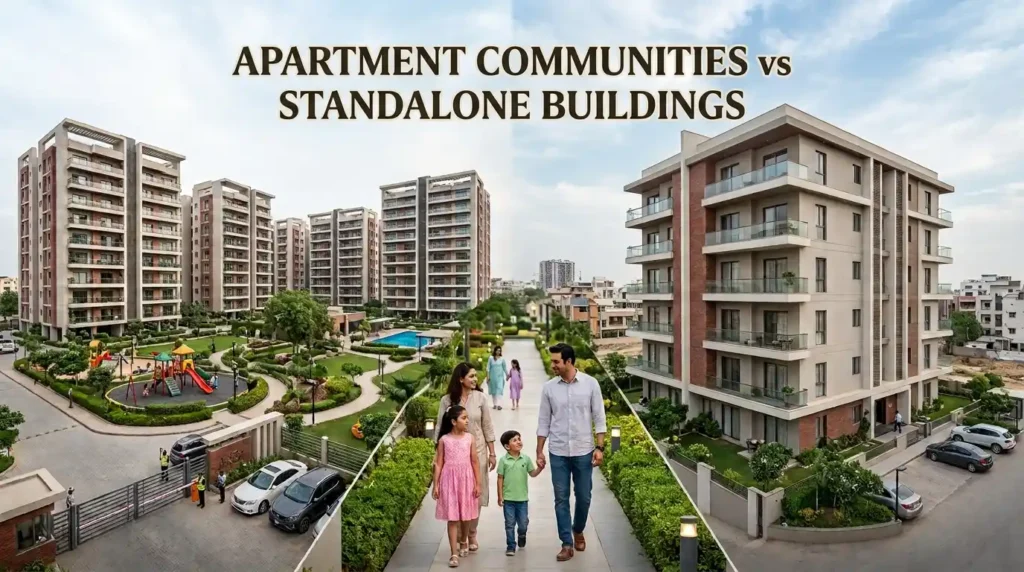
Both can work well for families, but they offer pretty different lifestyles. Apartment communities are built around shared amenities, organized management, and a sense of community. Standalone buildings tend to give you more privacy, fewer shared spaces, and a bit more flexibility.
So which one’s actually better?
Honestly, it depends on your family your lifestyle, your budget, and what you expect from a home.
This guide walks through both options so you can make a decision that actually fits your situation.
What Is an Apartment Community?
An apartment community is a residential development made up of several buildings or towers, all managed together as one bigger project.
These developments usually come with shared facilities think security systems, controlled entrances, parking, elevators, kids’ play areas, green spaces, community halls, gyms, pools, backup power, and proper waste management.
The real appeal here is that you’re not just buying an apartment you’re becoming part of a bigger residential setup. For families with kids, that’s a big draw, since there’s often a dedicated space for children to play while parents get the added comfort of better security and convenience.
What Is a Standalone Apartment Building?
A standalone building, on the other hand, operates on its own it’s not part of some larger planned complex.
It could have just a handful of units or dozens of them. Quality varies a lot here too some standalone buildings are modern with proper elevators, parking, and security, while others offer just the basics.
The main draw is simplicity and privacy. You get fewer shared amenities, sure, but you also skip some of the costs and the general buzz that comes with living in a big community.
Quick Comparison
| Feature | Apartment Communities | Standalone Buildings |
|---|---|---|
| Security | Usually stronger, more organized | Depends on the building’s management |
| Amenities | More extensive | Usually limited |
| Children’s facilities | Often available | Rarely available |
| Community environment | Strong | More private |
| Maintenance | Centralized | Building-specific |
| Parking | Usually planned | Can be limited |
| Privacy | Moderate | Often higher |
| Lifestyle | Community-oriented | Independent |
| Service facilities | More comprehensive | Basic to moderate |
| Monthly charges | Can be higher | Often lower |
| Family convenience | Generally high | Depends on the building |
| Property selection | Multiple units/projects to choose from | Building-specific |
| Long-term appeal | Often strong | Depends heavily on location and building |
1. Security and Safety
For families, this is usually the first thing on the list.
Apartment communities tend to have a more organized security setup simply because everything runs under one centralized management. Depending on the project, that might mean gated entrances, security guards, CCTV, visitor management, controlled access, and even emergency response systems in place.
That kind of setup can bring real peace of mind, especially if you’ve got young kids or elderly family members at home.
Standalone buildings can have guards and cameras too, but honestly, it really comes down to how well the specific building is managed and how involved the residents are.
Winner: Apartment communities — if organized security is your priority, a well-run community usually has the edge.
2. Children’s Play Areas and Family Amenities
If you’ve got kids, this one matters a lot.
Bigger residential communities usually come with play areas, open spaces, gardens, and recreational facilities built right in meaning your kids don’t have to go far to socialize and play.
A standalone building, though, is often just the apartment itself. Families there usually end up relying on nearby parks or playgrounds instead.
Having all of that within walking distance genuinely makes daily life easier for parents.
Winner: Apartment communities
3. Privacy
This is where standalone buildings really pull ahead.
Big communities can feel busy packed lobbies, shared recreational spaces, more visitors coming and going, and just generally more people around. Some families love that energy. Others would rather avoid it entirely.
Standalone buildings usually have fewer residents and fewer shared spaces, which naturally makes for a quieter, more private feel. That said, privacy still depends a lot on the actual layout, which floor you’re on, and how close your neighbors are.
Winner: Standalone buildings if privacy tops your list, this is probably the better fit.
4. Maintenance and Property Management
This is one of the clearest differences between the two.
A well-run apartment community usually has dedicated teams handling everything cleaning, landscaping, elevators, security, generators, water systems, and repairs to common areas. That kind of centralized approach makes life a lot easier for families.
Standalone buildings can have maintenance teams too, but the quality really varies. In some buildings, residents end up coordinating repairs themselves or relying on a small building committee to get things done.
Winner: Apartment communities for families who want things handled without having to chase anyone down.
5. Parking Facilities
Parking has become a real headache for a lot of urban families, and it’s worth checking closely before you buy.
Modern apartment communities usually offer designated and visitor parking with things properly organized. Standalone buildings can be fine too, but older or smaller ones sometimes just don’t have enough space to go around.
Before signing anything, it’s worth confirming the number of parking spots, whether it’s shared or dedicated, who actually owns the parking rights, and how secure and accessible it is. A gorgeous apartment can become a daily headache fast if parking’s a mess.
Winner: Depends on the project don’t assume communities automatically win here. Check the actual parking plan first.
6. Community Living
Apartment communities are basically built around the idea of neighbors knowing each other.
Residents naturally cross paths in lobbies, parks, gyms, and community halls, which means kids make friends easily and parents build relationships with the people next door.
Standalone buildings, by comparison, tend to offer a quieter, more independent way of living.
Winner: Apartment communities great for families who enjoy that social side of things.
7. Monthly Maintenance Costs
Here’s where apartment communities can start to feel expensive.
Premium developments often charge monthly maintenance fees that cover security, cleaning, landscaping, elevators, pools, gyms, and general upkeep. Standalone buildings usually charge less, mostly because there’s simply less to maintain.
But cheaper monthly fees don’t always mean cheaper overall a poorly maintained building can eventually hit you with expensive repair bills out of nowhere.
Winner: Standalone buildings, on cost alone but always weigh cost against what you’re actually getting for it.
8. Convenience for Busy Families
Between work and school, most families today are stretched thin on time, and this is where apartment communities really shine.
A well-planned development might bundle in retail shops, restaurants, gyms, parks, and kids’ areas sometimes the whole project sits close to schools, hospitals, and shopping centers too. That cuts down a lot of daily running around.
Winner: Apartment communities
9. Noise and Resident Density
More people generally means more noise more traffic, more visitors, busier common areas, just more activity in general.
Standalone buildings, with fewer residents, tend to feel calmer. Though again, that really depends on construction quality, the surrounding roads, and where exactly the building sits.
Winner: Standalone buildings a solid pick if peace and quiet matter more than anything else.
10. Access to Schools and Daily Essentials
No matter what type of building you choose, location still matters more than almost anything else.
Think about how close you’ll be to schools, hospitals, grocery stores, mosques, parks, and your workplace. A standalone apartment in a great location can genuinely beat a big community that leaves you commuting an hour each way.
Winner: Depends on location always weigh this alongside the property itself, not separately.
11. Quality of Construction and Building Management
Construction quality can honestly go either way, regardless of which type you pick.
Before buying, it’s worth checking the structural condition, plumbing, electrical work, fire safety, backup power, and the building’s maintenance history. A well-run standalone building can easily outperform a poorly managed community and the reverse is just as true.
Winner: Depends on the property the developer, build quality, and management track record matter far more than the category itself.
12. Lifestyle and Family Preferences
At the end of the day, it comes down to how your family actually likes to live.
An apartment community might suit you better if you want: stronger organized security, play areas for the kids, shared amenities, a real sense of community, professional maintenance, and planned parking.
A standalone building might suit you better if you want: more privacy, lower monthly costs, fewer neighbors, a quieter home, and a more independent way of living.
Which Fits Your Family Type?
| Family Type | Recommended Option |
|---|---|
| Family with young children | Apartment community |
| Family prioritizing security | Apartment community |
| Family wanting children’s facilities | Apartment community |
| Large family needing privacy | Depends on the unit/building |
| Couple seeking quiet living | Standalone building |
| Family with elderly members | Well-managed apartment community |
| Budget-conscious family | Depends on total cost |
| Social, community-oriented family | Apartment community |
| Privacy-focused family | Standalone building |
| Investor prioritizing amenities | Depends on location and demand |
Is an Apartment Community a Better Investment?
Not necessarily.
Property investment comes down to a lot more than just the type of building location, developer reputation, construction quality, rental demand, and legal documentation all matter just as much, if not more.
A family-friendly community can attract tenants because of its amenities and security. But a well-located standalone apartment can pull in just as much rental demand if it offers privacy, accessibility, and a fair price.
What Should Families Check Before Buying?
Whether you go for a community or a standalone building, inspect the property carefully. Here’s what’s worth checking:
Security — Ask about guards, CCTV, and how visitors are managed.
Building approvals — Verify ownership documents and legal approvals before committing to anything.
Maintenance — Understand exactly what the monthly charges actually cover.
Parking — Confirm your parking rights and how much is actually available.
Utilities — Check water, electricity, gas, backup power, and waste disposal.
Elevators — Ask how they’re maintained and what the backup plan is if one breaks down.
Fire safety — Look for exits, extinguishers, alarms, and clear emergency procedures.
Children’s facilities — If you have kids, go see the playgrounds yourself rather than relying on photos.
Location — Time your commute to schools, work, and hospitals realistically.
Future resale — Think about whether the property will still appeal to families years down the line.
So, Which Is Actually Better for Families?
There’s really no one-size-fits-all answer here.
Apartment communities tend to work better for families who care most about security, amenities, and a sense of community. Standalone buildings suit families who’d rather have privacy, quiet, and lower running costs.
What matters most is not making this decision purely based on the building type. A well-managed community in a great location can offer an excellent family lifestyle and a well-maintained standalone building in a good spot can offer just as much value, with more privacy to boot.
It really comes down to your family’s priorities, your budget, and where you see yourselves in the years ahead.
Final Verdict
When you’re comparing apartment communities against standalone buildings, think beyond just the apartment itself.
A home needs to offer more than bedrooms and a living room it should give you security, convenience, reliable upkeep, and a lifestyle that actually works for your whole family.
For families with kids, communities often have the edge thanks to organized security, play areas, and professional management. For those who value privacy and independence, standalone buildings remain a solid choice.
Before you commit, look closely at the location, build quality, management, amenities, maintenance costs, parking, and legal paperwork of the actual property you’re considering.
The best home for your family isn’t necessarily the biggest or the flashiest one it’s the one that fits how you actually live, day to day, for years to come.
Frequently Asked Questions
Are apartment communities better for families?
Often, yes — they tend to offer better organized security, play areas, and professional maintenance. But it’s still worth evaluating the specific project rather than assuming.
What’s the main difference between the two?
An apartment community is part of a larger planned development with shared amenities and centralized management. A standalone building runs independently, usually with fewer shared facilities.
Are standalone apartments more private?
Generally, yes. Fewer residents and fewer shared spaces usually mean a quieter, more private living experience.
Which is safer for children?
A well-managed apartment community often has better child-friendly security controlled entrances, cameras, staff, and dedicated play areas. Still, it’s worth checking the actual arrangements yourself.
Do apartment communities cost more in maintenance?
Usually, yes, especially with more amenities on offer. But those fees typically cover real services like security, cleaning, and upkeep of shared facilities.
Which is better for elderly family members?
A well-run apartment community can be genuinely convenient elevators, security, and easy access to shared spaces all help. Just confirm accessibility features before buying.
Which has better resale value?
Neither wins automatically. Location, build quality, developer reputation, and demand all play a bigger role than the type of building itself.
What should families check before buying?
Security, construction quality, legal approvals, maintenance costs, parking, utilities, fire safety, kids’ facilities, location, and resale potential.
Are apartment communities good for investment?
They can be, especially in high-demand areas with solid management and amenities. Still, always check rental yield and total ownership costs first.
So which one’s actually better?
For most families wanting amenities, security, and community life, a well-managed apartment community tends to be the stronger pick. Families who value privacy and quiet may lean toward a standalone building instead.