12 Reasons Jinnah Avenue Is Better Than Many Housing Projects 2026
Introduction
Buying property in Karachi used to come down to one question: which listing is cheapest? That’s changed. Buyers today are asking better questions where exactly is this located, how easy is the commute, is the neighborhood already established or still finding its feet, and will this property still be desirable when I want to sell it?
That shift in thinking is a big part of why Jinnah Avenue has been showing up more and more in Karachi property conversations lately.
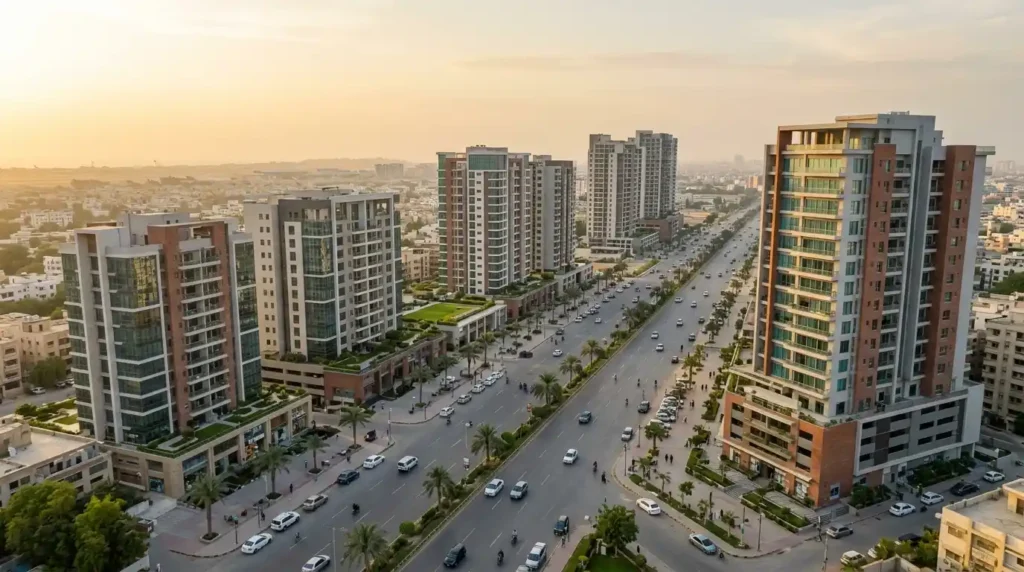
The corridor sits within reach of Malir Cantt, Gulistan-e-Johar, Jinnah International Airport, and several of the city’s major routes, and current listings show a genuinely large concentration of apartments and residential projects packed along it. (Raabty)
What makes it interesting isn’t just the new construction it’s that buyers can get into a modern apartment here without moving far from parts of Karachi that already work.
Does that make it objectively better than every housing project in the city? No and anyone telling you that is oversimplifying things. Every project has its own trade-offs, and due diligence still matters just as much here as anywhere else. But when you weigh location, connectivity, real residential demand, and lifestyle together, Jinnah Avenue does have some genuine advantages over a lot of the more isolated developments popping up around Karachi.
Here’s the case for it — twelve reasons worth thinking through in 2026.
1. It Sits at a Genuinely Useful Crossroads
Location is where a lot of otherwise-impressive projects quietly fail. A building can have great architecture and a long amenities list, but if getting to work, school, or the airport eats two hours of your day, none of that matters much in practice.
Jinnah Avenue’s advantage is that it sits close to Malir Cantt, Gulistan-e-Johar, and the airport area — area guides consistently describe the corridor in relation to these three anchors. (Pins)
That kind of positioning tends to matter to a wide range of people: working professionals, families, frequent flyers, business owners, students, and investors thinking about long-term demand.
The underlying point is simple connectivity is one of the biggest drivers of whether a property stays desirable once the initial excitement of a new launch wears off.
2. Its Closeness to Malir Cantt Is a Real Selling Point
Several developments on Jinnah Avenue actively market their nearness to Malir Cantt, and it’s not just a marketing line projects like Metropolis Residency and Burj Al-Jinnah are genuinely positioned right along that stretch. (Zameen)
For a lot of families, being close to an established cantonment area carries real weight it feeds into perceptions of security, accessibility, and settled surroundings that a brand-new development in an unproven part of the city simply can’t offer on day one.
If you want a modern apartment but don’t want to lose that sense of an established neighborhood nearby, this is exactly the kind of trade-off Jinnah Avenue is built around.
3. You’re Buying Into an Area, Not Just One Building
Here’s a distinction that matters more than most buyers realize going in: when you buy inside a single, self-contained housing project, your day-to-day life ends up tied to whatever that project’s internal facilities happen to offer. If the gym is mediocre or the shops are limited, you’re stuck with it.
A corridor like Jinnah Avenue works differently. The market already includes a real cluster of residential buildings Metropolis Residency, Burj Al-Jinnah, Ibrahim Heaven, Burj-Ul-Ohad, Metropolis Signature, and others all sitting within the same general stretch. (Zameen)
That gives you an actual neighborhood ecosystem rather than one isolated compound, which in practical terms means more choice in restaurants, shopping, services, schools, healthcare, jobs nearby, and entertainment. The surrounding area starts to matter just as much as which specific building you pick.
4. Apartments Genuinely Dominate Here
If you’re specifically apartment-hunting, Jinnah Avenue is worth a serious look, because that’s what most of the market here actually is. Current listings show hundreds of residential properties along the corridor, and flats make up the overwhelming majority of them. (Zameen)
That lines up with where Karachi’s housing preferences have been heading generally fewer buyers wanting a sprawling independent house, more wanting something manageable: 2-bed, 3-bed, or 4-bed apartments, duplexes, penthouses, or serviced units. Jinnah Avenue leans hard into exactly that demand.
5. There’s Enough Variety to Actually Fit Different Buyers
No single apartment size works for everyone. A newly married couple, a family with three kids, and an investor chasing a premium penthouse are all looking for completely different things and Jinnah Avenue’s listings span a wide enough range to accommodate most of them, from compact starter apartments right up to large duplexes and penthouses. (Zameen)
That range means you can actually shop by budget, family size, lifestyle, and investment goal rather than settling for whatever’s available.
A first-time buyer might find a smaller apartment a manageable way into the market. A growing family might need the extra room a 3- or 4-bed unit provides. And buyers chasing something more premium can look at the duplexes, penthouses, and serviced apartments coming onto the corridor.
6. Modern Living Without Cutting Yourself Off From the Rest of Karachi
Some of Karachi’s newer housing projects sit well outside the established urban core. That can mean quieter, more open surroundings — but it often comes at the cost of a genuinely brutal daily commute.
Jinnah Avenue threads a different needle: newer residential construction sitting right alongside access to parts of Karachi that already function. Projects along the corridor are increasingly built around modern architecture, high-speed elevators, backup power, security, dedicated parking, parks, pools, gyms, and children’s play areas features that current project listings for the corridor confirm are becoming standard rather than exceptional. (Kings Group)
For buyers who want contemporary apartment living without relocating to the edge of the city, that combination is a genuine draw.
7. It Works for Both People Who Want to Live There and People Who Want to Invest
Some neighborhoods only really make sense for investors chasing appreciation. Others only make sense for people who actually want to live there. Jinnah Avenue has a decent shot at appealing to both.
If you’re planning to actually move in, the draw is the connectivity, the range of apartment choices, the proximity to established areas, and the modern amenities showing up in newer projects.
If you’re investing, what matters more is genuine residential demand, the pace of new development, realistic rental potential, and how active the resale market actually is. The sheer number of active listings along the corridor points to a real, functioning residential market not a speculative land play waiting on future promises. (Zameen)
That distinction matters more than people give it credit for. A location with real end-user demand gives an investment a much sturdier foundation than one propped up purely by hype.
8. Lifestyle Here Extends Beyond the Building Itself
A well-built housing project can give you a gym, a pool, and a community hall. But lifestyle isn’t only about what’s inside the gate it’s also about what’s around it.
Jinnah Avenue’s surrounding environment brings in a growing mix of residential activity, commercial life, restaurants, retail, services, major roads, schools, and employment hubs which means residents aren’t stuck relying entirely on one project’s internal commercial strip for everyday needs.
Think of it this way: an isolated project usually means home, then internal facilities, then a long drive before you reach anything else. A connected location like Jinnah Avenue means home, then nearby services, then straight onto major roads into the rest of the city. For most urban families, the second version is simply more livable day to day.
9. The Rental Case Is Genuinely Strong
Location matters enormously for rental property specifically. Tenants are weighing commute time, security, building quality, parking, nearby amenities, unit size, and how well the building is maintained often more than they’re weighing the rent itself.
Jinnah Avenue’s connectivity and the sheer density of apartment buildings along it make it a natural fit for rental demand, and active sale listings across several developments confirm this is a live, functioning market rather than a dormant one. (Zameen)
That said, don’t mistake a good location for a guaranteed return. Before buying for rental income, actually run the numbers:
Annual Rent ÷ Total Purchase Cost × 100 = Gross Rental Yield
And don’t stop there factor in maintenance charges, likely vacancy periods, property taxes, repairs, and management costs before deciding the yield actually works for you.
10. You’re Not Locked Into One Developer
One underrated benefit of a growing corridor rather than a single gated project: competition. When multiple developers are building in the same stretch, you get to actually compare rather than take whatever one company offers.
Jinnah Avenue currently has several active projects side by side Metropolis Residency, Burj Al-Jinnah, Ibrahim Heaven, and others giving buyers a real basis for comparison. (Zameen)
Worth putting side by side across projects: distance from the main road, total price, covered area, layout, amenities, parking arrangement, security setup, backup power, monthly maintenance, documentation, the developer’s track record, and how active resale demand actually is for comparable units.
The point isn’t to buy something just because it’s “on Jinnah Avenue.” It’s to use that broader market to compare intelligently within it.
11. It’s Gaining Real Recognition, Not Just Hype
Jinnah Avenue has been showing up more frequently in Karachi’s property media, with coverage pointing to growing investor attention alongside a steadily expanding number of active listings on major property platforms. (Nukta)
That kind of recognition matters because property value isn’t only about today’s demand — it’s shaped by how a location matures over years. As more residents, developers, businesses, and services move in, the whole ecosystem tends to strengthen. That’s not a guarantee of price growth, but it does tend to build sturdier fundamentals than a location that’s still entirely dependent on future promises.
12. Al Rauf Gold Residency Adds to the Momentum
For anyone specifically researching Jinnah Avenue right now, Al Rauf Gold Residency is one of the newer names worth knowing.
Al Rauf Group recently launched the project on Main Jinnah Avenue, directly opposite Malir Cantt Check Post No. 6 a Ground Plus 10 residential development built around more than 15 amenities and a distinctly modern apartment concept. (Al Rauf Group)
It’s a fairly clean example of where the corridor is heading: buyers increasingly want contemporary apartment living in a location that’s already well-connected, rather than gambling on somewhere isolated.
That said, a good location doesn’t excuse skipping the basics. Before considering this or any similar project, verify the approvals, go through the payment plan carefully, understand the actual possession timeline, inspect the specifications in person, factor in maintenance costs, look into the developer’s history, compare it against competing projects, and evaluate the total cost — not just the monthly installment number that looks good on a brochure.
Jinnah Avenue vs. a Typical Standalone Housing Project
So why might Jinnah Avenue edge out a lot of isolated developments? It’s really the combination of factors, not any single one.
| Factor | Jinnah Avenue | Isolated Housing Project |
|---|---|---|
| Major-road connectivity | Strong | Varies |
| Apartment availability | Strong | Depends on project |
| Established surroundings | Relatively strong | Often still developing |
| Property choices | Multiple developments | Usually limited |
| Lifestyle options | Wider surrounding area | Often project-dependent |
| Rental potential | Location-dependent | Location-dependent |
| Developer choice | Multiple projects | Usually one developer |
| Resale comparison | Multiple properties | Project-specific |
| Access to Malir Cantt | Strong relevance | Depends on location |
| Airport-side accessibility | Convenient | Varies |
| Modern apartments | Widely available | Depends on project |
| Investment flexibility | Multiple options | More concentrated |
The advantage isn’t one feature doing all the work — it’s connectivity, real residential development, and genuine choice reinforcing each other.
Is Jinnah Avenue Better Than DHA or Bahria Town?
This one needs a fair answer, not a sales pitch. Jinnah Avenue shouldn’t be treated as automatically superior to every established community in Karachi — that’s just not how these comparisons work.
DHA Karachi runs on a completely different model: planned phases, mature infrastructure, and a broad residential-and-commercial ecosystem built up over decades.
Bahria Town Karachi offers yet another model — master-planned development, large-scale community facilities, and a tightly controlled residential environment.
Jinnah Avenue’s pitch is different from both: urban connectivity, apartment-focused living, closeness to Malir Cantt, and access to established parts of the city.
Jinnah Avenue makes sense if you care most about: connectivity, apartment living, proximity to Malir Cantt, airport-side access, urban convenience, and having multiple projects to compare.
Other housing communities make more sense if you care most about: large plots, independent villas, gated master-planned living, extensive internal amenities, or a quieter, more suburban pace.
Who Actually Fits Jinnah Avenue?
Families looking for modern apartments with convenient access to Karachi’s major hubs tend to find the location genuinely useful.
Professionals working around Malir, Shahrah-e-Faisal, Gulistan-e-Johar, or nearby commercial zones benefit directly from the connectivity.
Frequent travelers get real value from the airport-side positioning — something a lot of Karachi neighborhoods simply can’t offer.
Overseas Pakistanis buying from abroad tend to prioritize exactly what this corridor offers — location, building management, security, maintenance, and resale potential — over flashier internal amenities.
Rental investors have a genuine market here worth researching, particularly for well-laid-out apartments with decent connectivity.
First-time buyers may find apartments here a more realistic entry point than trying to stretch for an independent house elsewhere in the city.
What to Actually Check Before Buying
No matter how convinced you are that the location is right, never buy purely on location. Go through the fundamentals.
Confirm the legal status — ownership, approvals, and the paperwork that backs them up.
Look into the developer’s track record — what have they actually delivered before, and on time?
Inspect construction quality yourself — materials, structure, finishing, and common areas, not just the show unit.
Understand exactly where the project stands — under construction, near completion, ready for possession, or already occupied.
Ask about maintenance charges — both current cost and how they’re likely to increase.
Confirm parking is properly allocated and documented, not just verbally promised.
Check how electricity backup actually works, not just that it exists on paper.
Verify the real water supply arrangement rather than trusting the marketing copy.
Research realistic rental rates for comparable units if you’re investing.
Look at how often similar units are actually changing hands to gauge real resale liquidity.
The Biggest Mistake Buyers Keep Making
The single most common mistake in Karachi real estate is buying off a brochure. A brochure will happily show you a pool, a gym, a mosque, a park, and a lobby that looks like a five-star hotel.
A serious buyer asks different questions instead: Where exactly is this project? Who’s actually building it? What have they delivered before this? What approvals genuinely exist? What’s the realistic possession date? What will maintenance actually cost month to month? What are comparable units selling for right now? And the question that cuts through most of the marketing noise who’s going to want to buy this from me five years from now?
Those questions matter far more than any rendering ever will.
Bottom Line: Why Jinnah Avenue Deserves a Spot on Your Shortlist in 2026
Jinnah Avenue isn’t automatically better than every housing project in Karachi no honest guide would claim that. But it does combine a set of genuine advantages that make it worth serious consideration heading into 2026: strategic connectivity, closeness to Malir Cantt, access to major routes, a strong apartment market, multiple competing developments, modern lifestyle features, real rental potential, wider property choice, growing residential activity, airport-side convenience, established surroundings, and a steady stream of new premium projects.
The real strength here isn’t any single building it’s the position Jinnah Avenue occupies between modern residential development and established urban connectivity. For a lot of buyers, that combination is worth more than owning a unit with an impressive amenities list sitting in the middle of nowhere.
So don’t ask “is Jinnah Avenue the best?” That’s the wrong question. Ask instead: does Jinnah Avenue actually offer the location, property type, lifestyle, and investment fundamentals that match what I’m trying to achieve? If the answer’s yes, it earns a real spot on your Karachi property shortlist just don’t skip the due diligence to get there.
Frequently Asked Questions
Why is Jinnah Avenue becoming popular?
Its connectivity, closeness to Malir Cantt, access to the airport-side area, and growing concentration of residential developments and apartments are the main drivers. (Raabty)
Is Jinnah Avenue a good place to buy an apartment?
It can be the area has a large selection of apartments spread across multiple developments, and current listings show flats making up the bulk of what’s available. (Zameen)
Is Jinnah Avenue good for property investment?
It may suit investors who value connectivity, genuine residential demand, and an area that’s actively developing. Still, look closely at the specific project’s documentation, pricing, rental potential, developer history, and resale market before committing.
Is Jinnah Avenue near Malir Cantt?
Yes — several developments and listings along Jinnah Avenue are specifically positioned near Malir Cantt. (Zameen)
Is Jinnah Avenue near Karachi’s airport?
Yes, it sits in the airport-side part of the city, with area guides consistently placing it in relation to Jinnah International Airport, Gulistan-e-Johar, and Malir Cantt. (Pins)
What kinds of properties are available on Jinnah Avenue?
Mostly apartments, along with some larger duplexes, penthouses, and a smaller number of houses. Current listings confirm apartments as the dominant property type in the area. (Zameen)
What should I check before buying on Jinnah Avenue?
Approvals, ownership documents, the developer’s track record, construction quality, possession status, parking, utilities, maintenance charges, payment terms, and resale potential.
Is Jinnah Avenue better than DHA Karachi?
Not necessarily they offer different things. Jinnah Avenue suits buyers who want apartment living, strong connectivity, and closeness to Malir Cantt and the airport-side area. DHA suits buyers who prefer established planned phases, larger houses, and a different overall lifestyle.
Is Jinnah Avenue suitable for families?
Yes, for many families the apartment variety, connectivity, and access to established areas all work in its favor. That said, how suitable a specific project is depends on its own security, parking, utilities, maintenance, and family-oriented amenities.
Is Jinnah Avenue suitable for rental investment?
It can be, particularly for well-laid-out apartments with solid building management, parking, and connectivity. Run the actual numbers realistic market rent against total acquisition cost before assuming the yield works.
What makes Jinnah Avenue different from an isolated housing project?
It’s a broader residential corridor rather than one enclosed development, which means buyers can compare multiple projects and benefit from a wider surrounding commercial and transportation network rather than being tied to one gated community. (Zameen)
Is Al Rauf Gold Residency located on Jinnah Avenue?
Yes Al Rauf Group launched it on Main Jinnah Avenue, opposite Malir Cantt Check Post No. 6, describing it as a Ground Plus 10 project with more than 15 amenities. (Al Rauf Group)
Final Takeaway
Jinnah Avenue’s real advantage isn’t the buildings going up along it — it’s the location itself. For buyers comparing options across Karachi in 2026, a genuinely well-connected residential corridor tends to offer a more practical mix of accessibility, lifestyle, choice, and long-term usability than an isolated project ever can on its own.
But location should be where your research starts, not where it ends. Choose the right location, compare the right project, verify the right documents, and invest based on what actually matches your own goals not just what looks good in a brochure.